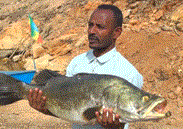
The Benishangul-Gumuz Regional Agriculture Bureau has announced that more than 10,700 tons of fish were harvested from Negat Lake, which is formed from Aby River and feeds water to the Great Ethiopian Renaissance Dam (GERD).
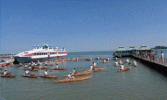
The country produced the fishes during the Ethiopian fiscal year concluded July 7, 2026, according to the report by the state news agency ENA. Negat Lake, the vast artificial reservoir created by the Grand Ethiopian Renaissance Dam (GERD), has become more than just a source of hydroelectric power and a tourist attraction. It is also creating employment opportunities through fish production.
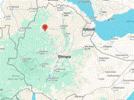
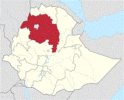
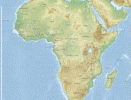
Located in Guba in the Benishangul-Gumuz Region, Negat Lake is home to more than 70 islands. Its unique landscape and environment make it an attractive destination for recreation and tourism.
The lake has also become an important economic asset, particularly for the people of Benishangul-Gumuz and nearby communities, by providing new sources of income and economic opportunities.
In addition to supporting fisheries, Negat Lake has significant potential for tourism, inland water transportation, and environmental conservation by helping maintain the area’s ecological and climate balance.
The Deputy Head of the Animal and Fisheries Development Sector at the regional Agriculture Bureau, Dr. Birhanu Iticha, said that 46 fishing cooperatives are currently operating on the lake.
He noted that 10,799 tons of fish were produced from Negat Lake alone during the fiscal year, demonstrating the region’s growing fish production capacity.
According to Dr. Birhanu, fish production has doubled compared to the 2017 Ethiopian fiscal year, and additional cooperatives are expected to begin operations in the coming year.
Besides Negat Lake, fish are also produced in significant quantities and quality from the Dabus, Didessa, and Beles rivers, with production expected to expand further during the current fiscal year.
Fish produced in the region is supplied to Addis Ababa and other cities, becoming an increasingly important source of income for producers.
Dr. Birhanu added that Negat Lake is creating employment opportunities for many young people through the fisheries sector.
Young people organized into cooperatives are earning income by catching and marketing fish, enabling them not only to support themselves but also to improve the livelihoods of their families.