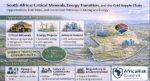
By Africa Risk Control / ANALYSIS – Africa is increasingly becoming central to one of the most consequential economic transformations of the 21st century: the global transition toward clean energy, digital technologies, and advanced manufacturing. At the center of this transformation are critical minerals—including copper, cobalt, lithium, nickel, manganese, and rare earth elements—materials that serve as essential components in electric vehicles, renewable energy systems, power storage technologies, and modern electronics.
As global demand for these resources accelerates, Africa’s mineral reserves are drawing growing attention from governments, investors, and multinational corporations seeking to secure reliable supply chains. The International Energy Agency (IEA) has highlighted the strategic importance of critical minerals in enabling the global energy transition, noting that demand for key minerals could increase several-fold over the coming decades.
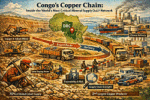
Several African countries are already central to global supply networks. The Democratic Republic of Congo (DRC) produces roughly 70 percent of the world’s cobalt, a key component in lithium-ion batteries. Zambia remains one of the world’s major copper producers, while countries such as Zimbabwe, Namibia, and Mali are emerging as significant sources of lithium and other battery minerals.
These resources place Africa at the center of a rapidly evolving geopolitical and economic competition over mineral supply chains. The World Bank has noted that the demand for minerals required for renewable energy technologies could increase dramatically as countries accelerate decarbonization efforts.
However, the expansion of mineral production across the continent also highlights several structural challenges.
Infrastructure constraints remain a major obstacle in many mining regions. Transport corridors, port capacity, and power supply limitations can significantly affect the ability of mining operations to deliver consistent export volumes.
Governance and regulatory frameworks also vary widely across African jurisdictions. Changes in taxation policies, local content requirements, and mining regulations can influence the economic viability of long-term projects.
Environmental and social considerations are another growing factor shaping investment decisions. International investors are increasingly applying Environmental, Social, and Governance (ESG) standards when evaluating mining projects. Responsible sourcing and transparency in supply chains have therefore become essential components of mineral sector development.
According to the United Nations Economic Commission for Africa, the continent has an opportunity not only to export raw materials but also to develop regional value chains that support mineral processing and manufacturing.
For investors and companies operating in the sector, understanding these dynamics is critical. While Africa’s mineral wealth presents enormous opportunities, successful projects require careful evaluation of regulatory environments, infrastructure capacity, and political stability.
Companies entering African mineral markets must therefore prioritize rigorous due diligence, supply chain verification, and ongoing geopolitical risk monitoring.
EDITOR’S NOTE– The contributor of this analysis, Africa Risk Control (ARC) is a due diligence and risk advisory service provider operating in dozens of African countries. Corporate Due Diligence, Risk Advisory, Country Risk Insights, Background Checks, Identity Verification (for banks, governments, and institutions), Verification for Citizenship by Investment / Donations Programs, Verification for Permanent Residency by Investment / Donation Programs, Source Wealth Verification, Competitor Intelligence, and Market Entry Research are some of the major services ARC has been providing.