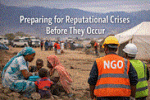
By BEHAK – Non-governmental organizations operate in environments where public trust is essential to their ability to deliver programs effectively. Because NGOs often work with vulnerable communities, public funds, and international partnerships, their activities are frequently subject to scrutiny from multiple stakeholders.
In this context, allegations or investigations—whether related to governance, safeguarding, financial management, or program implementation—can quickly attract public attention. When such situations arise, the manner in which organizations respond becomes as important as the outcome of the investigation itself.
Across Africa’s development landscape, NGOs may encounter allegations for various reasons. Some arise from misunderstandings about program activities or administrative procedures. Others may stem from operational disagreements, internal disputes, or political sensitivities surrounding development initiatives.
In certain cases, allegations may be serious and require formal investigations to determine facts.
Regardless of their origin, allegations create reputational risks that organizations must manage carefully.
A common challenge during such moments is balancing transparency with due process. NGOs must ensure that investigations are conducted fairly and thoroughly while also communicating responsibly with stakeholders who expect accountability.
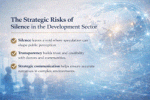
Silence can create uncertainty, yet premature statements can compromise investigative processes. Structured communication protocols help organizations navigate this balance.
When allegations emerge, organizations should first focus on verifying information internally. Leadership teams must assess the credibility of claims and determine whether formal investigations are necessary. Clear internal procedures ensure that responses remain grounded in facts rather than speculation.
Once an investigation is initiated, communicating this step transparently often helps reassure stakeholders. Donors, government partners, and communities typically recognize that responsible institutions investigate allegations when they arise. Acknowledging that a review process is underway demonstrates accountability without prejudging outcomes.
Another critical element involves maintaining respect for all parties involved. Investigations often involve individuals whose reputations and careers may be affected. Responsible communication avoids assumptions about guilt or innocence while emphasizing the organization’s commitment to fairness and integrity.
This balanced approach helps protect both institutional credibility and individual rights. Independent oversight can also strengthen confidence in investigative processes. In some cases, organizations may appoint external auditors or experts to review allegations objectively. Such measures reinforce transparency and reassure stakeholders that investigations are conducted impartially.
Media attention often accompanies allegations involving development organizations. Journalists may seek clarification about events or institutional responses. Engaging responsibly with credible media outlets can help ensure that public narratives reflect verified information rather than speculation.
Another important consideration is internal communication.
Staff members should be informed appropriately when investigations occur, particularly if rumors begin circulating within the organization. Clear internal communication helps maintain morale and prevents misinformation from spreading among employees.
Once investigations conclude, organizations should communicate outcomes transparently. If allegations are substantiated, institutions must demonstrate that corrective actions are taken. This may involve disciplinary measures, policy reforms, or strengthened oversight mechanisms.
When allegations are not substantiated, communicating findings clearly helps restore confidence among stakeholders.
In both cases, the goal is to reinforce the principle that accountability is integral to responsible development work. Investigations, while challenging, can also provide opportunities for institutional learning. Organizations that review procedures, strengthen governance frameworks, and communicate improvements demonstrate commitment to continuous improvement.
For NGOs operating across Africa’s diverse development contexts, credibility depends not only on program outcomes but also on how institutions manage moments of scrutiny.
Handling allegations with professionalism, transparency, and fairness strengthens institutional trust.
Ultimately, development organizations exist to serve communities and advance social progress. Protecting the credibility necessary to continue this work requires responsible management of both operational challenges and reputational risks.
EDITOR”S NOTE: BEHAK, an Africa-based strategic communications and media advisory firm headquartered in Addis Ababa, works with companies, NGOs, development agencies, and mission-driven enterprises to strengthen credible media visibility across African and international platforms.
Through structured media engagement, narrative development, leadership profiling, and policy-focused communication strategy, BEHAK enables organizations to translate complex field operations into clear, defensible public narratives. Its approach prioritizes accuracy, institutional maturity, and long-term reputation management – ensuring that impactful climate and humanitarian work receives the visibility and recognition it merits within competitive funding and policy environments.