By BEHAK / Travel Blog – The Entoto mountain range rises above Addis Ababa, forming a natural boundary that defines both the physical and symbolic structure of Ethiopia’s capital. At over 3,200 meters above sea level, Entoto is not only the highest peak in the city but also a vantage point from which Addis Ababa’s sprawling districts can be observed in their entirety.
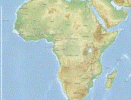
For visitors, the ascent from the bustling city center to the mountain’s cooler, forested slopes represents a shift in perspective—geographically, environmentally, and historically. This transition is emblematic of Ethiopia’s broader geography, where altitude plays a decisive role in shaping climate, culture, and settlement patterns. More than half of Ethiopia’s landmass lies above 1,500 meters, earning it the nickname “Roof of East Africa.”
Historical Significance: Menelik II’s First Capital
Entoto holds a foundational place in the story of Addis Ababa. Before the city was formally established in the late 19th century, Emperor Menelik II chose Entoto as his imperial seat, building palaces and churches that remain today.
The Entoto Maryam Church, where Menelik was crowned, still stands as a testament to this era. The site was not only a royal residence but also a strategic military vantage point, offering protection and visibility across the highlands.
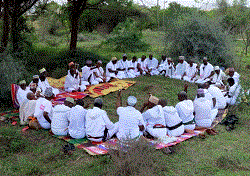
Unlike modern districts such as Bole or Piazza, which reflect later phases of urban expansion, Entoto represents the origins of Addis Ababa’s urban identity. Its monasteries and relics preserve Ethiopia’s religious and cultural traditions, linking the mountain to the nation’s broader historical narrative.

Landscape and Ecology: The “Lung of Addis Ababa”
Entoto’s environment differs sharply from the city below. Its eucalyptus forests, introduced during Menelik’s reign and expanded under Haile Selassie, earned it the nickname “the lung of Addis Ababa.” These forests provided firewood and construction materials for generations, while today they serve as a vital ecological buffer.
The mountain’s altitude ensures cooler temperatures and cleaner air, offering respite from urban congestion. Views from Entoto stretch across the city, situating Addis Ababa within its broader geographic context. Conservation efforts, such as the Entoto Natural Park project, aim to restore native vegetation and protect biodiversity, reinforcing the mountain’s role in climate resilience.
Movement and Access
Entoto lies just 10 kilometers north of central Addis Ababa, accessible by car, taxi, or organized tours. The ascent is rapid but transformative: temperatures drop, vegetation thickens, and the city’s noise fades into silence. Within Entoto, movement is less structured than in the city center. Visitors often explore through hiking, guided tours, or casual walks to historical and natural sites.
Recreation and Contemporary Use
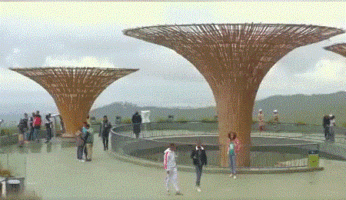
In recent years, Entoto has evolved into a recreational hub. The development of Entoto Park has introduced walking and cycling trails, picnic areas, cafes, and cultural exhibits. Adventure activities such as zip-lining, horseback riding, and archery attract younger visitors, while religious sites continue to serve worshippers.
This blend of history and modern leisure makes Entoto a multidimensional destination. It is simultaneously a sacred space, a cultural archive, and a recreational retreat.
Sustainable Tourism and Urban Development
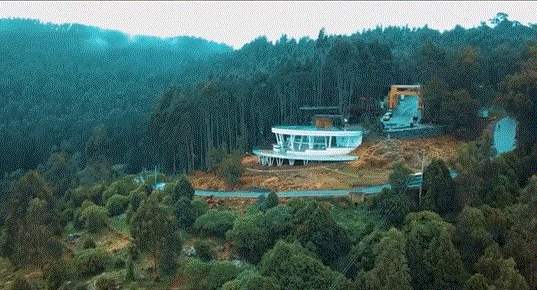
Entoto is central to Addis Ababa’s broader push for sustainable tourism. The Entoto Riverside project integrates ecological restoration with urban vibrancy, creating wetlands, reforested areas, and inclusive public spaces. This initiative not only enhances biodiversity but also provides equitable access for communities, artisans, and small businesses.
Such projects highlight Ethiopia’s ambition to position Addis Ababa as a model for eco-tourism and climate-adaptive urban planning. By combining cultural heritage with environmental stewardship, Entoto exemplifies how cities can balance modernization with conservation.
Local Services and Visitor Support
While Entoto lacks the dense hospitality infrastructure of districts like Bole, it offers a growing network of cafes, restaurants like Kategna and tour operators. Local guides provide historical interpretation, while recreational facilities cater to diverse interests. The park’s expansion has also created employment opportunities, particularly for women who previously relied on firewood collection, linking conservation with social equity.
Interpreting Entoto Within Addis Ababa
From its elevated position, Entoto allows visitors to grasp Addis Ababa’s scale and distribution. It complements experiences in the city’s commercial and cultural districts, offering a holistic understanding of how geography shapes urban life. Entoto is not merely a backdrop to Addis Ababa—it is a defining feature of its identity.
Conclusion: A Mountain of Many Dimensions
Entoto is more than a mountain; it is a convergence of history, landscape, and urban transformation. It embodies Ethiopia’s past through its royal and religious sites, sustains its present through ecological resilience, and points toward a future of sustainable tourism and inclusive development.
For visitors, Entoto offers more than panoramic views—it provides a lens through which to understand Addis Ababa itself. In the interplay of altitude, culture, and environment, Entoto reminds us that geography is not just a backdrop to human history, but an active force in shaping it.
EDITOR’S NOTE: This content is provided by BEHAK Multimedia PLC, a communications and public relations firm in Ethiopia and the publisher of New Business Ethiopia. BEHAK specializes in producing and publishing sponsored content that helps businesses boost visibility, build credibility, strengthen reputation, and support branding efforts. By incorporating carefully researched digital content with hyperlinks to company websites and social media pages, BEHAK enables businesses to promote their services to global potential clients.
Businesses interested in enhancing their digital visibility through such well researched sponsored content are invited to reach out directly to the BEHAK Team.