Following the footsteps of other countries, Ethiopia officiates fuel rationing by cutting its daily supply by more than half. Because of the delay of fuel supply due to the war between Israel, America and Iran, Ethiopia’s daily supply of white diesel has declined by half from 9.2 million liters to 4.5 million liters.
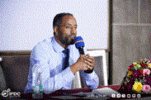
This is indicated by the Minister of Trade and Regional Cooperation Kassahun Gofe (PhD), who stated that Ethiopia’s long-term oil trade agreement with Middle Eastern countries was disrupted due to the war and the supplying countries announced that they would not be able to supply the product. As a result, he mentioned that more than 180,000 metric tons of fuel that was in the procurement process was not delivered.
“… Due to the war and instability, the daily supply of white diesel has decreased from 9.2 million liters to 4.5 million liters,” he said. The minister explained that the government is purchasing fuel from the neighboring market to alleviate the shortage and prevent social and economic activities from being hampered, and that it has been forced to purchase fuel at three times the price due to the increase in world oil prices.
Despite the significant increase in world oil prices, the government is currently subsidizing white diesel by 95 birr per liter and gasoline by 42 birr per liter to save the lives of citizens, he said. He said that so far, about 262 billion birr has been subsidized, and that 15 to 20 billion birr is being allocated for subsidies every month.
The Minister announced that the government has decided to prioritize fuel supply from today to ensure that the shortage of fuel does not put pressure on the socio-economic activities of the country and its citizens and to lead them fairly.
As a measure, the government of Ethiopia has listed below 7 categories of businesses, which get the priority in the fuel rationing decision:
1. Vehicles transporting fuel should be given priority at the filling station
2. Major producers and export organizations directly,
3. Government and private projects that require special attention directly,
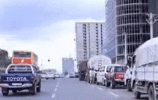
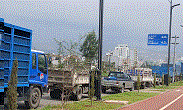
4. Vehicles transporting basic consumer goods, including import and export trade
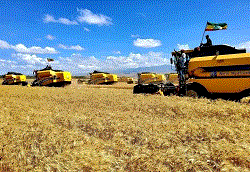
5. Tractors that modernize agriculture,
6. Urban and national public transport vehicles
7. Also, a priority fuel usage system will be implemented, which will allow public transport vehicles running on diesel to receive fuel first.
The minister said that action will be taken as fuel distribution outside this is inappropriate, and he also stated that he will work in coordination to implement this decision properly.