By BEHAK / Travel Blog – Addis Ababa is not simply Ethiopia’s capital—it is the country’s living gateway, a city where history, culture, and diplomacy converge. For many visitors, it serves as the first point of contact with Ethiopia, but to stop at that description would be to miss its deeper significance.
Addis Ababa is both a starting point and a destination in its own right, offering a framework for understanding how Ethiopia operates at multiple levels: administrative, cultural, and economic.
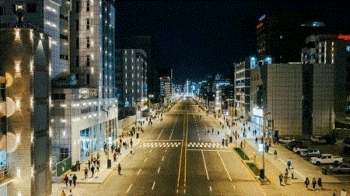
Unlike cities where tourism is concentrated in a few iconic zones, Addis Ababa presents a distributed urban environment. Its activities, services, and points of interest are spread across districts, each shaped by unique historical and functional characteristics. This creates a city less about singular attractions and more about navigating interconnected spaces—a mosaic of experiences that together define Ethiopia’s capital.
Urban Structure and Spatial Organization
The city’s urban fabric is layered and complex. Districts such as **Bole** function as commercial and hospitality centers, filled with hotels, restaurants, and nightlife. In contrast, older districts like Piazza reflect earlier phases of urban development, with colonial-era architecture and bustling markets. This juxtaposition of old and new is central to Addis Ababa’s identity.
Movement across districts is influenced by traffic conditions, elevation changes, and the city’s sprawling geography. For first-time visitors, this can be disorienting, but it also reveals the city’s dynamic character.
Addis Ababa’s growth trajectory has been shaped by domestic expansion and its role as a diplomatic hub. As the headquarters of the African Union, the city hosts international institutions and conferences, reinforcing its position within regional and global networks.
Cultural Systems and Everyday Life
Culture in Addis Ababa is not confined to museums or galleries—it is embedded in daily life. The **coffee ceremony**, a cornerstone of Ethiopian identity, is practiced in homes, cafes, and public spaces, linking tradition with modern social interaction. Coffee culture here is not just about consumption; it is about community, conversation, and continuity.
Markets such as Merkato, one of Africa’s largest open-air markets, showcase the city’s diversity. Religious institutions, from Orthodox churches to mosques, stand alongside modern cultural venues, reflecting Ethiopia’s pluralism.
These environments are not curated for tourists but function as integral components of urban life. Visitors engage with systems that are active and evolving, requiring adaptability and observation rather than passive consumption.
Movement and Accessibility
Addis Ababa’s accessibility is shaped by its road networks, traffic patterns, and transport services. While distances between districts may appear manageable, travel time varies significantly depending on conditions. Transport options include traditional taxis, ride-hailing apps, and private vehicles. For longer journeys, the city is anchored by Addis Ababa Bole International Airport, one of Africa’s busiest aviation hubs.
Connectivity is reinforced by Ethiopian Airlines
Ethiopian Airlines, Africa’s largest carrier, which positions Addis Ababa as a central node in continental and global aviation. This makes the city not only Ethiopia’s gateway but also a transit point for travelers across Africa and beyond.

Hospitality and Urban Experience
The hospitality sector reflects Addis Ababa’s dual role as a national capital and international gateway. Accommodation ranges from globally recognized hotel chains to locally managed guesthouses. Restaurants and cafes offer both Ethiopian cuisine—such as injera with spicy stews—and international fare. Nightlife is concentrated in districts like Bole, where live music venues and lounges thrive.
This diversity allows visitors to tailor their experience. Business travelers may gravitate toward international hotels and conference centers, while cultural explorers may prefer smaller guesthouses near traditional neighborhoods. The city’s hospitality ecosystem mirrors its broader identity: layered, diverse, and adaptable.
Local Services and Visitor Support
Visitor services in Addis Ababa are widely available and relatively structured. Tour operators, guides, and transport providers facilitate movement within the city and toward regional destinations such as Lalibela or the Simien Mountains. Car rental services, translation support, and travel coordination providers further enhance accessibility.
These networks form the operational foundation through which visitors engage with both the city and Ethiopia at large. They reflect Addis Ababa’s role as a hub for organizing travel across the country, ensuring that the capital is not just a gateway but also a staging ground for deeper exploration.
Interpreting Addis Ababa as a Destination
Addis Ababa is often positioned as a gateway rather than a destination. Yet this perspective overlooks the city’s complexity. It is a point of transition between international and domestic contexts, but it also offers its own forms of engagement. Cultural interaction, urban exploration, and institutional presence all contribute to its significance.
For visitors, understanding Addis Ababa involves recognizing it as both an entry point and an environment shaped by overlapping systems. It is a city where diplomacy, commerce, and culture intersect, offering insights into Ethiopia’s broader dynamics.
Concluding Perspective
Addis Ababa represents a convergence of administrative, cultural, and logistical functions. Its layered structure reflects Ethiopia’s diversity and dynamism, offering a lens through which the country can be understood. For visitors, the city provides both context and connectivity, shaping how travel is initiated and experienced.
To see Addis Ababa only as a stopover is to miss its essence. It is a living gateway—one that embodies Ethiopia’s past, present, and future, and one that continues to evolve as Africa itself transforms.
EDITOR’S NOTE: This content is provided by BEHAK Multimedia PLC, a communications and public relations firm in Ethiopia and the publisher of New Business Ethiopia. BEHAK specializes in producing and publishing sponsored content that helps businesses boost visibility, build credibility, strengthen reputation, and support branding efforts. By incorporating carefully researched digital content with hyperlinks to company websites and social media pages, BEHAK enables businesses to promote their services to global potential clients.
Businesses interested in enhancing their digital visibility through such well researched sponsored content are invited to reach out directly to the BEHAK Team.