By BEHAK – Ethiopia’s tourism landscape is not organized around a single dominant attraction, but rather a set of distinct regions, each defined by its own historical, environmental, and cultural characteristics. For visitors, this means that travel within the country is less about moving between similar destinations and more about transitioning across fundamentally different contexts.
Understanding Ethiopia’s key destinations therefore requires a structured perspective. Rather than viewing them as isolated sites, it is more useful to consider how each location contributes to a broader national narrative shaped by history, geography, and cultural continuity.
Northern Historical Circuit: Continuity and Religious Heritage
The northern region of Ethiopia is often regarded as the historical core of the country. It is here that some of the most significant archaeological and religious landmarks are located.
The ancient city of Axum represents one of the earliest centers of civilization in sub-Saharan Africa. Its monumental stelae, archaeological remains, and religious associations provide insight into a society that played a key role in early trade networks connecting Africa, the Middle East, and beyond.
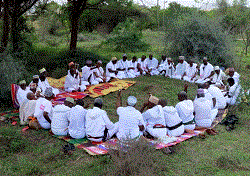
Further south, Lalibela presents a different form of historical expression. The rock-hewn churches, carved into volcanic rock, remain active religious sites and pilgrimage destinations. Their continued use distinguishes them from heritage sites that exist primarily as preserved monuments.
These locations are recognized internationally by UNESCO reflecting their global cultural significance. However, their primary importance remains embedded in local religious and social practices.
For visitors, the northern circuit offers a concentrated exposure to Ethiopia’s historical depth, but it also requires an understanding of the religious context that shapes these sites.
Highland Ecosystems: Landscape and Biodiversity
Ethiopia’s highland regions introduce a different dimension of travel, defined by altitude, biodiversity, and environmental scale. The Simien Mountains National Park is one of the most prominent examples. Characterized by steep escarpments and high-altitude plateaus, the park supports endemic wildlife species such as the Gelada monkey and the Walia ibex. Its landscape is often described in geological terms due to the scale and structure of its formations.
The ecological significance of the Simien region has been referenced in environmental and conservation analyses, including those supported by the World Bank, which highlight Ethiopia’s diverse natural resource base.
Travel in these regions typically involves trekking and guided exploration, reflecting both the terrain and conservation considerations. Unlike urban destinations, access and movement are shaped by environmental conditions rather than infrastructure alone.
Rift Valley and Water Systems: Ecology and Settlement
Ethiopia’s Rift Valley introduces a landscape structured around lakes, volcanic activity, and agricultural systems.
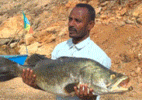
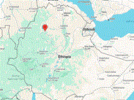
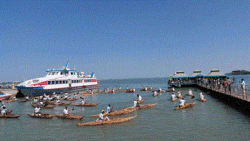
Lake Tana, located in the northwest, holds both ecological and historical significance. As the source of the Blue Nile, it plays a role in regional hydrology, while its island monasteries preserve religious manuscripts and traditions.
Further south, the Rift Valley lakes support agricultural activity, fishing communities, and emerging tourism infrastructure. These areas provide a different type of visitor experience, one that is less focused on monumental heritage and more on environmental interaction and local economies.
From a tourism development perspective, such regions are increasingly relevant. Institutions such as the UN World Tourism Organization have identified lake regions and eco-tourism environments as growth areas within global travel trends.
Extreme Environments: Geological Significance and Controlled Access
Among Ethiopia’s most distinctive destinations is the Danakil Depression, located in the Afar region. This area is characterized by extreme temperatures, active volcanic systems, and mineral-rich formations. It is often described as one of the most inhospitable environments on Earth, with conditions shaped by tectonic activity and geothermal processes.
Unlike other destinations, access to the Danakil Depression is typically structured through organized expeditions. This reflects both safety considerations and logistical requirements.
Travel here is less flexible and more dependent on coordination, making it distinct from other regions in Ethiopia.
Its significance extends beyond tourism. The Danakil region is frequently referenced in geological and scientific research, contributing to broader understanding of Earth systems.
Urban Gateway: Addis Ababa as a Transitional Space
Most international visitors enter Ethiopia through Addis Ababa, which functions as both a logistical hub and a cultural introduction to the country. The city is connected globally through Ethiopian Airlines positioning it as one of Africa’s key aviation centers.
Addis Ababa presents a different layer of Ethiopia’s identity. It combines administrative, diplomatic, and commercial functions with cultural institutions and a growing hospitality sector. While it may not have the same concentration of historical monuments as the northern regions, it provides essential context for understanding contemporary Ethiopia.
National tourism coordination and promotion are supported by the Ethiopian Tourism Organization, which plays a role in shaping how destinations are presented to international audiences.
Structuring Travel Across Regions
One of the defining characteristics of travel in Ethiopia is the need to navigate between regions that differ significantly in climate, infrastructure, and cultural context.
A typical itinerary may involve:
• Highland environments (Simien Mountains)
• Historical centers (Lalibela, Axum)
• Lowland or extreme environments (Danakil Depression)
• Urban transition points (Addis Ababa)
This diversity is a strength, but it also requires planning. Travel time, altitude changes, and logistical coordination all influence how itineraries are structured.
Domestic aviation, road networks, and guided tours are commonly used to manage these transitions. The role of national carriers such as Ethiopian Airlines is particularly important in connecting distant regions efficiently. In addition, local chartered flight service provides such as Abyssinia Flights are also available for visitors especially where the national career has limited coverage.
Local Services and Visitor Support
Across Ethiopia, visitor services are structured around both formal hospitality providers and locally embedded support systems. In major urban centers such as Addis Ababa, accommodation ranges from international-standard hotels to locally managed establishments, supported by a growing network of restaurants, cafes, and transport providers.
In regional destinations, including areas surrounding Lalibela, Simien Mountains National Park, and Lake Tana, visitor support is more closely integrated with local economies. This includes tour operators, guides, vehicle rental services, and small-scale businesses such as souvenir vendors and traditional restaurants.
These service networks play an essential role in enabling access to Ethiopia’s diverse travel environments, while also reflecting the localized nature of tourism development across the country.
Concluding Perspective
Ethiopia’s key travel destinations are not interchangeable components of a standardized tourism model. Each region reflects a distinct combination of historical development, environmental conditions, and cultural practices.
For visitors, this means that travel is less about moving through a sequence of attractions and more about engaging with different systems of meaning and context. The country’s tourism value lies precisely in this diversity.
Understanding Ethiopia, therefore, involves recognizing how its destinations connect to broader narratives—of history, ecology, and society—rather than approaching them as isolated points of interest.
EDITOR’S NOTE: This content is provided by BEHAK Multimedia PLC, a communications and public relations firm in Ethiopia and the publisher of New Business Ethiopia. BEHAK specializes in producing and publishing sponsored content that helps businesses boost visibility, build credibility, strengthen reputation, and support branding efforts. By incorporating carefully researched digital content with hyperlinks to company websites and social media pages, BEHAK enables businesses to promote their services to global potential clients.
Businesses interested in enhancing their digital visibility through such well researched sponsored content are invited to reach out directly to the BEHAK Team.