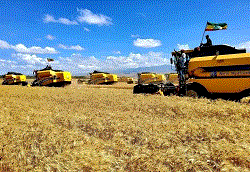
Agricultural investment, one of the strategic sectors identified in Ethiopia’s Ten-Year Agricultural Development Plan, is achieving significant success in meeting national goals such as ensuring food security, substituting imported products with locally produced goods, and increasing foreign exchange earnings.
By utilizing the country’s vast agricultural potential, numerous domestic and foreign investors have actively engaged in agricultural development projects across the nation. According to data from the Ministry of Agriculture, more than 2.3 million hectares of land are currently under agricultural investment nationwide and are being managed by 8,904 investors.
To further expand the sector, the government is undertaking various initiatives, including improving land access, enhancing the availability of financial services, promoting contract farming, and facilitating infrastructure development.
In addition, efforts are being made to introduce locally developed technologies to investors in order to accelerate agricultural transformation. Significant achievements are being recorded through modern farming practices, contract farming systems, improved seed multiplication, and supportive legal frameworks implemented as part of the country’s ongoing reforms.
Currently, flowers, vegetables, fruits, crops, and livestock are being developed extensively through investment projects and are being supplied both to the domestic market and to export destinations.
For example, in the flower, vegetable, and fruit export sector, Ethiopia exported 309,866.8 tons of products in the 2020/21 fiscal year (2013 E.C.), generating revenue of $531.48 million.
By the 2024/25 fiscal year (2017 E.C.), export performance had grown significantly, with 395,911.9 tons of products exported, generating $670.63 million in revenue.
Looking at the performance of the current fiscal year’s first ten months, the Ministry reports that 236,415.3 tons of products have been exported, generating $408.2 million in revenue.
On the other hand, livestock investment—another priority sector that makes a substantial contribution to the national economy, job creation, and knowledge transfer—has also received significant attention.
Over the past five years alone, investors engaged in livestock development have been allocated 112,000 hectares of land. In addition, 643,000 hectares have been allocated for agricultural and horticultural investments. In total, more than 750,000 hectares of land have been transferred for development purposes.
EDITOR”S NOTE: This content was first published on Afar Communications Bureau social media page.