By BEHAK / Analysis – Ethiopia is building at a pace that is hard to ignore. Tower cranes dominate Addis Ababa’s skyline, new highways cut across the countryside, and mega projects such as the USD 12.5 billion Bishoftu International Airport promise to transform the nation into a continental hub.
Yet behind the steel and concrete, another story is quietly unfolding: the rise of Ethiopia’s domestic ceramics industry. At the center of this transformation is Tulefa Ceramic, the country’s largest manufacturer, now preparing to challenge decades of import dependency.
A Local Giant Emerges
For decades, Ethiopia’s ceramic needs—tiles, sanitary ware, and finishing products—were met almost entirely through imports, mainly from China and the Middle East. Tulefa Ceramic’s expansion marks a turning point. With a major distribution agreement signed in 2026, the company aims to meet 70% of Ethiopia’s ceramic demand through local production and distribution networks.
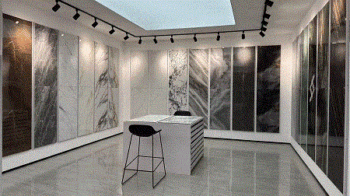
“We want to prove that Ethiopia can produce world-class ceramics,” said a Tulefa spokesperson during the company’s showroom launch in Addis Ababa. “Our goal is not only to replace imports but to create a brand that can stand proudly in regional markets.”
The factory, located in Tulefa town in the Amhara region, was built with an investment of USD 50 million and spans 30 hectares. It is capable of producing over 35,000 square meters of tiles per day, according to industry reports. This scale of production is unprecedented in Ethiopia and signals a new era where local manufacturers can compete with imports not only in volume but also in quality.
Construction Boom Driving Demand
The timing could not be better. Ethiopia’s construction sector has been expanding at double-digit growth rates, driven by urbanization and infrastructure investment. The Bishoftu International Airport alone is expected to be Africa’s largest aviation hub, easing congestion at Addis Ababa Bole International Airport and positioning Ethiopia as a gateway to the continent.
Real estate developments in Addis Ababa—luxury apartments, office complexes, and mixed-use projects—are multiplying, while government-led housing programs are expanding demand for affordable finishing materials.
“Tiles and ceramics are no longer a luxury item,” explained Abebe Mekonnen, a real estate developer in Addis Ababa. “They are a necessity. Every new apartment project, every office tower, every government housing block needs them. Having a local supplier like Tulefa changes the economics completely.”
Ceramics are at the heart of this growth: from airport terminals to residential bathrooms, tiles and sanitary ware are indispensable. The sheer scale of Ethiopia’s construction boom means the ceramics market is set to expand rapidly, and Tulefa is stepping in at precisely the right moment.
Imports vs. Local Production
Historically, Ethiopia leaned heavily on imports, but the balance is shifting. In 2021, imports accounted for nearly USD 180 million, while local production was a modest USD 25 million. By 2024, imports rose to USD 220 million, but local production had tripled to USD 60 million.
With Tulefa’s products entry, estimates for 2026 suggest imports at USD 250 million and local production at USD 150 million. Forecasts for 2030 even predict local production overtaking imports, reaching USD 300 million compared to imports at USD 280 million.
Imports will remain important for high-end porcelain and specialty ceramics, but Ethiopia is clearly moving toward self-sufficiency. “We used to wait months for imported tiles to arrive at the port,” recalled Hirut Alemu, a contractor working on government housing projects. “Now we can source locally, and the prices are more stable. It makes a huge difference.”
Ethiopia’s Natural Resource Advantage
One of Ethiopia’s greatest strengths lies beneath its soil. According to the Ministry of Mines, the country is rich in raw materials essential for ceramics: kaolin clay deposits in Oromia and Amhara, feldspar and quartz reserves critical for tile and sanitary ware production, and limestone and gypsum, already widely used in cement.
“These minerals are Ethiopia’s hidden advantage,” noted a senior official at the Ministry of Mines. “We have the raw materials to support not just domestic production but exports. The challenge is to build the industrial base to process them efficiently.”
This resource base is not only a foundation for self-sufficiency but also a springboard for exports. Ethiopia’s geology provides the raw ingredients for a ceramics industry that could rival regional competitors.
Export Potential
As local capacity grows, Ethiopia could become an exporter of ceramic products to neighboring markets. East Africa—Kenya, Tanzania, and Uganda—imports large volumes of ceramics. Djibouti and Somalia rely heavily on imports for construction. With Ethiopia’s geographic position and new logistics infrastructure, including Bishoftu Airport, export channels to the Middle East could also open.
“If Ethiopia can scale production and maintain quality, it has a ready market in East Africa,” said Samuel Otieno, a Nairobi-based construction consultant. “Kenya alone imports millions of dollars’ worth of tiles every year. A competitive Ethiopian product could easily find buyers.”
If Ethiopia achieves economies of scale, ceramics could join cement and steel as key export commodities, diversifying the country’s industrial base. The potential is significant: Ethiopia could move from being an import-dependent market to a regional hub for ceramic products.
Market Outlook
The ceramics market is projected to grow at 13–15% annually between 2025 and 2029, doubling in size by 2031 compared to 2024. Local manufacturers are expected to capture the majority share, with Tulefa leading the charge. Price competitiveness will be crucial: local production reduces transport costs and import duties, making ceramics more affordable for middle-income housing projects.
The economic impact is significant—domestic manufacturing reduces foreign currency outflows, creates thousands of jobs, and ensures supply chain resilience amid global shipping disruptions. Ethiopian consumers also benefit from products tailored to local needs and standards, ensuring quality and accessibility.
A Narrative of Industrial Independence
Ethiopia’s ceramics industry is no longer just about imports—it’s about building a homegrown sector that matches the country’s ambitious construction agenda. With daily production capacity of 40 to 45 containers of ceramic products, Tulefa Ceramic’s rise is symbolic: a local champion stepping into a market once dominated by foreign suppliers. With abundant natural resources, a booming construction sector, and mega projects reshaping demand, Ethiopia is on track to become not just self-sufficient in ceramics, but a regional exporter.
The cranes over Addis Ababa tell one story of Ethiopia’s future. The tiles beneath them tell another: a nation laying the foundations of industrial independence, one ceramic at a time.
For potential customers—whether developers, contractors, or homeowners—Tulefa Ceramic’s products are easily accessible through its major distributor showroom in Addis Ababa, located at Kasanchis, Joburg Plaza. The showroom offers a full range of tiles, sanitary ware, and finishing products, with expert staff available to advise on large-scale projects or individual purchases.
Customers in Ethiopia and beyond can reach the distributor directly by phone at +251951444442 or +251951444440, or explore product lines and updates via the official website or social media pages of the company such as, Telegram, Facebook, and LinkedIn, among others. This direct access ensures that builders and buyers alike can source high-quality ceramics without the delays and costs often associated with imports.
EDITOR’S NOTE: This content is provided by BEHAK Multimedia PLC, a communications and public relations firm in Ethiopia and the publisher of New Business Ethiopia. BEHAK specializes in producing and publishing sponsored content that helps businesses boost visibility, build credibility, strengthen reputation, and support branding efforts. By incorporating carefully researched digital content with hyperlinks to company websites and social media pages, BEHAK enables businesses to promote their services to global potential clients.
Businesses interested in enhancing their digital visibility through such well researched sponsored content are invited to reach out directly to the BEHAK Team.