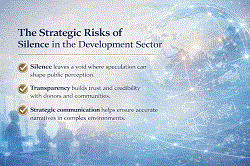
By BEHAK – Across the development sector, many non-governmental organizations have traditionally believed that remaining quiet in public discourse helps protect their neutrality. While this approach may once have reduced exposure to controversy, the modern information environment has changed dramatically. Today, silence can create risks.
Development programs operate within complex ecosystems where narratives evolve quickly. Journalists, policy analysts, researchers, and community voices interpret development initiatives continuously. When organizations do not communicate about their work, others often fill the information gap.
Transparency and communication are widely recognized as key principles of responsible development practice. The Core Humanitarian Standard emphasizes that communities and stakeholders should have access to clear and reliable information about humanitarian and development programs.
In many cases, these interpretations are well intentioned. But without accurate context, narratives can become incomplete or misleading. For NGOs operating across Africa, this dynamic can affect how stakeholders perceive their work. Donors reviewing funding proposals increasingly conduct reputational research before committing resources.
Governments evaluating partnerships look for evidence of credibility and accountability. Communities receiving services want to understand who is delivering programs and why. When credible public information about an organization is limited, these stakeholders may find it difficult to assess the institution’s role or track record.
Silence therefore does not eliminate scrutiny. Instead, it can amplify uncertainty. Responsible communication provides an alternative. By ensuring that accurate information about programs exists within credible media platforms and professional discourse, NGOs create reference points that help audiences understand their work.
Independent journalism plays an important role in this process. When development initiatives are documented responsibly by media outlets, they gain third-party validation that internal reports alone cannot provide.
Public communication also strengthens institutional resilience. Organizations that maintain consistent public narratives are better prepared to respond if questions or controversies arise. Stakeholders already have context for interpreting events rather than encountering an institution that appears unfamiliar.
Importantly, responsible communication does not mean aggressive promotion. Strategic communication focuses on transparency and clarity. It ensures that information about programs, objectives, and challenges is accessible to those who need to understand them.
For NGOs committed to long-term impact, credibility is one of their most valuable assets. Maintaining that credibility requires ensuring that accurate narratives about development work are visible within the broader information environment.
Silence once offered protection. In today’s interconnected world, thoughtful communication often provides the stronger safeguard. Read the full article on BEHAK website.
EDITOR”S NOTE: BEHAK, an Africa-based strategic communications and media advisory firm headquartered in Addis Ababa, works with companies, NGOs, development agencies, and mission-driven enterprises to strengthen credible media visibility across African and international platforms.
Through structured media engagement, narrative development, leadership profiling, and policy-focused communication strategy, BEHAK enables organizations to translate complex field operations into clear, defensible public narratives. Its approach prioritizes accuracy, institutional maturity, and long-term reputation management – ensuring that impactful climate and humanitarian work receives the visibility and recognition it merits within competitive funding and policy environments.