As Ethiopia approaches 2026, localized conflict dynamics remain one of the most important variables shaping operational and investment decisions. While national-level progress continues in several areas, Africa Risk Control’s (ARC) field-verified intelligence indicates that instability remains uneven across regions. These dynamics require close monitoring, particularly for investors relying on mobility, supply chains, or long-duration project timelines.
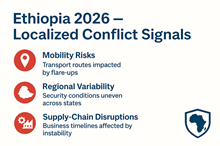
A common misconception among external observers is that Ethiopia’s security situation can be understood through broad national indicators. In reality, conflict exposure in the country follows localized patterns that vary by region, district, and corridor. Some areas have seen stabilization, while others continue to experience sporadic clashes, political friction, or disruptions tied to local grievances. These variations have a direct impact on investment feasibility and operational planning.
One critical area of concern is mobility risk. Localized conflict can affect key transport routes, distribution networks, and field operations — sometimes with little advance warning. For companies operating in logistics, agribusiness supply chains, construction projects, and humanitarian operations, these risks can lead to delays, rerouting costs, or temporary suspension of activity. ARC’s regional reporting has tracked how local disruptions can escalate quickly into operational bottlenecks.

Another challenge arises from political-security overlap. Certain regions face tension linked to administrative boundaries, local power shifts, or competition over resources. While these are not nationwide issues, they influence the predictability of operations at the local level. Companies basing decisions on outdated assumptions from previous years may underestimate how these dynamics affect access, compliance, and partnership management.
Community-level tensions also remain relevant. In some areas, disputes over land, identity, or resource allocation create friction that can spill into broader operational risk. These dynamics are not always captured in high-level country reports but significantly affect project timelines, especially for sectors requiring local engagement such as agriculture, energy, mining, and infrastructure.
Despite these challenges, certain regions continue to demonstrate improving security conditions, with more predictable patterns and clearer operating windows. Understanding where these stabilizing trends are emerging — and how they differ from areas facing persistent tension — is essential for developing realistic timelines and mitigation strategies.
ARC’s Ethiopia Country Risk & Due Diligence Report — 2026 Q1 Premium Edition provides region-level vulnerability mapping, conflict-pattern analysis, and forward-looking scenarios based on months of field reporting across Ethiopia and ARC’s intelligence network spanning 32 African countries. The report helps organizations distinguish between manageable operational exposure and areas requiring heightened monitoring.
As Ethiopia enters a crucial phase in 2026, investors and operators must base decisions on localized, continuously updated intelligence rather than generalized assumptions. Managing conflict-linked risk is not only possible — it is essential for safeguarding capital, partnerships, and operational continuity.
ARC’s Ethiopia Country Risk & Due Diligence Report — 2026 Q1 Premium Edition addresses these blind spots by providing field-verified analysis and forward-looking scenario models. The report helps investors build realistic timelines, identify exposure points, and design mitigation strategies tailored to their sector and operational footprint.
For organizations planning Ethiopia engagements in 2026, understanding and addressing operational blind spots early is essential. The cost of getting it wrong continues to rise—but so does the value of making informed, intelligence-driven decisions.
Request free Summary: info@africariskcontrol.com
Get the full Ethiopia Country Risk & Due Diligence Report — Premium Edition 2026 / Q1
Alternatively you can get the Ethiopia Micro Risk Brief — Q1 2026 – the 15 pages extract of the report, which is launched a few days ago upon the requests from its clients.
Africa Risk Control is launched by a group of award winning business & investigative journalists and due diligence experts in Africa to help global investors, corporations, and institutions make confident decisions in Africa’s dynamic markets.