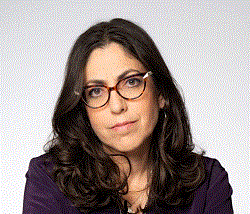
In this interview, we speak with Sarit Zehavi, a retired Lt. Col. and founder of the Alma Research and Education Center. Located just kilometers from the Lebanese border, Alma provides expert analysis on Israel’s northern security challenges. Zehavi offers her perspective on the multi-front conflict with Iran and its proxies, the threat of a nuclear Tehran, and explores growing ties with Ethiopia as a strategic regional ally.
New Business Ethiopia: Could you briefly introduce yourself and the Alma Research and Education Center?
Sarit Zehavi: I am the founder and president of the Alma Research and Education Center. I’m a retired Lieutenant Colonel and I have an MA in Middle-Eastern Studies. I live up north in Israel, 9 km from the Lebanese border. The Alma Center specializes in Israel’s security challenges on the northern borders, meaning Hezbollah, everything that’s happening in Syria and in Lebanon and also the IRGC (Iranian Revolutionary Guards Corps) in Iran.
Our research is based mostly on open source information, social media and media, from mainly Arabic, Persian, and a little bit and English and Hebrew.
New Business Ethiopia: In your own words, what is Alma’s primary mission and the core problem it seeks to address?
Zehavi: Our mission is to create a platform of knowledge about Israel’s security challenges on the northern borders, in the issues that I’ve mentioned in order to make people understand what’s happening over here and actually to be honest to contribute to the legitimacy of the State of Israel to defend itself.
New Business Ethiopia: Your center is located in a very vulnerable area of northern Israel. What is the significance of basing Alma there?
Zehavi: I myself live as I’ve said, 9 kilometers from the border. Alma center is 10 km from the border. All my staff is living up north. This means that we don’t only read about what’s happening we experience what’s happening. I can see the interceptions of the drones that are coming from Hezbollah, rockets, IDF’s attacks in Lebanon, everything I can see from my balcony.
So it’s a different experience than to live in Tel Aviv. We know exactly we are affected by everything that is happening here and we know exactly what’s the price of not dealing with those threats.
New Business Ethiopia: How does the Alma Center assess the current multi-front situation involving Hamas, Hezbollah, the Houthis, and Iran?
Zehavi: The multi-front situation that we are facing is a result of an organized and planned Iranian plan to destroy the State of Israel by attacking it from various fronts at the same time, including boots on the ground from its proxies and they were preparing for this campaign for a long time and it basically was launched on October 7, 2023, even though I’m not sure everybody was coordinated around the date itself.
But the idea existed and they published it, they didn’t even hide their agenda. They thought that even if their military operation will not destroy us completely, it will bring us to the point that we will collapse internally and give up on our country. They were wrong. But as long as the Islamic Republic of Iran still exists, we will face the challenges that are the outcome of this idea of the multiform campaign.
New Business Ethiopia: What is your assessment of the current conflict between Israel and Iran? Do you believe Israel can prevent Tehran from obtaining a nuclear weapon?
Zehavi: I believe Israel MUST prevent Iran from obtaining a nuclear weapon. I believe that all countries in the world should join us in preventing Iran from having nuclear weapons because this would mean that Israel cannot defend itself. That anything that we will do against Iranian proxies or attacks of ballistic missiles, or whatever they will do, they will threaten us not to retaliate or not to attack them or not to defend ourselves, because they have nuclear weapons. And they will be willing to use it as well.
So we have to stop it and I believe that we can stop it. I hope that the Iranian people will assist in this, and they will go to the streets and get rid of this regime after the US and Israel will severely damage it.
New Business Ethiopia: Despite significant blows to Hezbollah’s leadership, the conflict on the northern border continues. What is your assessment of Israel’s ability to contain this threat, and how does this connect to the broader challenge posed by Iran?
Zehavi: Israel can make the Hezbollah threat much, much smaller than it used to be. It already did make it much smaller than it was on October 7, 2023, since the IDF succeeded in pushing them away from the fence, and giving more security to the Israelis that are living here with regard to the shoulder missiles that cannot be intercepted by the Iron Dome, and were truly a problem during the previous war in 2024.
In order to remove the threat of the rockets, those that are based in Beirut or north of the Litani River, as were launched at us yesterday more than 100 rockets, more things are needed, which is more Israeli attacks, and at the same time also against the force of the Islamic Republic, which is the sponsor of Hezbollah.
And a lot of activity from the Lebanese government to designate Hezbollah as a terrorist organization. So Israel will do whatever it can, as much as possible, but a lot of work is needed by the international community and the Lebanese government as well in order to remove the threat completely.
New Business Ethiopia: How do you evaluate the current security situation on Israel’s border with Syria, and what are your expectations for the near future?
Zehavi: To be honest, I think Syria is the next challenge. Ahmed Al-Shara didn’t prove to have changed as the founder of Al-Qaida in Syria. He established elementary schools, about 70 elementary schools all across Syria, that educate the children to follow Al-Qaida’s ideology, schools of HTS, the branch of Al-Qaida in Syria.
He massacred minorities and there is a list of proofs that shows that he did not change; the leadership of his army is composed of Jihadi commanders that are surrounding him wherever he goes. So, I’m very much worried about Syria. Now it’s quiet. The IDF is there to be a buffer between the Israeli civilians and the terrorists, but the IDF is only taking a very small part, it’s like a few hundred meters or a few kilometers, less than a few kilometers next to the border. It’s definitely not a game changer with regard to the question of what the state of Syria is, but it can prevent terrorists from entering into Israel.
New Business Ethiopia: Some observers suggest Israel is losing support from traditional Western allies, including within the US Democratic Party. What is your observation, and how crucial is it for Israel to regain this support?
Zehavi: I want to say that the problem is not the fact that Israel is losing support among those countries. It’s rather the fact that in those countries there is support for radical Islamic ideology, as was revealed in the past week that people support the Islamic Republic instead of supporting the Iranian people.
And it was demonstrated that what is actually happening in the universities and in the streets, it’s worse than antisemitism. It’s just hypocrisy, that betrayed the values of freedom and democracy that I was brought up with. And clearly I’m very worried about the future of those societies in Europe and even in the US if they will continue along those lines. It’s not about the State of Israel. This is like the byproduct of this process.
New Business Ethiopia: Some argue that social media has been a major factor in Israel losing trust internationally. What is your comment on this?
Zehavi: Social media has its part in defaming Israel across the world, but again, I think this is something deeper than that, that relates to the internal structures of the Western societies and the infiltration of radical ideologies to those societies, taking advantage of freedom of speech, to undermine those societies from within.
And as I’ve said, the Jewish or Israeli issue of anti-Semitism is just the byproduct of that. Social media is a tool, but as we’ve learned from human history, even when there is no social media – those who want to spread radicalism can do it.
New Business Ethiopia: What is your perspective on the strengthening Israel-Ethiopia relationship, particularly in light of Ethiopia’s interest in sea access and Israel’s interest in a strong regional ally? Could a more powerful Ethiopia contribute to regional peace and stability?
Zehavi: Following everything I’ve just said about the Western society, I do believe that strengthening Israel’s connections with the countries in Africa and in Asia can be very important for our economy and our international position. Ethiopia is part of that, especially with regard to its location, and I really hope that our leaders will understand that.
Moreover, we have a community of Jews from Ethiopia that are living here, so I think this could be also a bridge in this respect.
EDITOR”S NOTE: To hear the Iran side of the story, our platform will also feature an interview with an expert who explains the Iran side of the story.