With the help of KfW Development Bank, the German government’s official development bank, Ethiopia’s state owned financial institution – the Development Bank of Ethiopia (DBE) is set to provide €31 million in loans to support micro, small, and medium-sized enterprises (MSMEs) operating in conflict-affected areas.
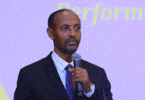
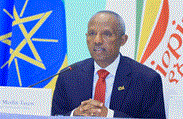
The concessional loan facility has been made possible through €31 million in financial support from the European Union and the KfW Development Bank, enabling loans to be offered at low interest rates. According to Mr. Tefera Befikadu, Director of Micro, Small and Medium Enterprises and Green Economy Projects at the Development Bank of Ethiopia, the financing will be provided under a favorable interest rate scheme.
Mr. Tefera explained that the loans will be disbursed through four selected commercial banks and one microfinance institution, allowing beneficiaries to access financing at reduced interest rates. The loan program targets enterprises located in the Afar, Amhara, and Tigray regional states. Eligible sectors include manufacturing, services, trade, construction, and agro-processing.
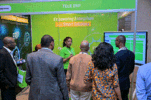
It was also announced that priority will be given to enterprises established by women and young entrepreneurs in the allocation of the loan fund. A validation workshop on the related assessment and review was held today at the Development Bank of Ethiopia. It is worth recalling that, in may 2026, the Development Bank of Ethiopia signed an agreement with its development partners to establish a concessional lending facility aimed at supporting enterprises in areas affected by conflict and natural disasters.
KfW Development Bank is the German government’s official development bank, handling financial cooperation with developing and emerging countries. It operates as part of the KfW Group, focusing on reducing poverty, fighting climate change, and securing sustainable economic growth globally.
DBE has completed a dramatic five-year turnaround, transforming from a policy lender near insolvency into a highly profitable institution. Managed under Ethiopian Investment Holdings (EIH), strategic financial restructurings have expanded the institution’s capital asset base to roughly 38 billion Br, securing its status as the nation’s second-largest bank.
Portfolio Reset and Fiscal Gains
Five years ago, agricultural defaults pushed DBE’s non-performing loan (NPL) ratio to a dangerous 57.6%. According to data tracked by Addis Fortune, aggressive forensic auditing and strict recovery frameworks successfully dragged that toxic asset ratio down into a safer regulatory band of 7.8% to 13.4%.To insulate capital, DBE shifted its core exposure away from unpredictable agrarian ventures toward industrial manufacturing.
The operational shift triggered historic financial growth, with annual revenues climbing past 18 billion Br and net profits stabilizing around the 8 billion Br threshold.
Structural Obstacles
Governance adjustments and executive leadership transitions remain closely watched by international credit partners. Furthermore, the bank faces friction with regional administrations over slow land title transfers and project foreclosures, while acute domestic foreign exchange shortages continue to delay critical industrial machinery imports.
Outlook
While systemic forex shortages and regional administrative friction remain key operational bottlenecks, DBE’s aggressive balance sheet cleanup, robust profit margins, and strict risk-mitigation frameworks have successfully stabilized the institution, positioning it as a resilient cornerstone of Ethiopia’s industrialization strategy.