Hundreds of Ethiopian women immigrants are rescued from misery in Saudi Arabia. A total of 1,834 Ethiopian nationals who had been living in difficult circumstances in Saudi Arabia have returned to Ethiopia, says Ministry of Women and Social Affairs of Ethiopia.
The returnees arrived during the week on eight repatriation flights. They included 1,604 men, 192 women, and 38 infants. Among those who returned were 53 minors under the age of 18. Since the government launched its repatriation program on September 15, 2025, more than 88,800 Ethiopians have been successfully returned to the country.
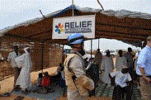
The ministry stated that it is working closely with relevant stakeholders and development partners to provide returning citizens with the necessary support and care at the airport and temporary reception centers, as well as to facilitate their reunification with their families.
In addition, the ministry noted that it is implementing rehabilitation and reintegration programs, in collaboration with partner organizations, to support migrants who return after becoming victims of irregular migration to various countries.
Looking ahead, the ministry said it will further strengthen its efforts to raise public awareness about the dangers of human trafficking, prevent irregular migration, and promote safe and regular migration.
The Kafala Crisis, Repatriation, and Rehabilitation of African Migrant Women
The intersection of Saudi Arabia’s restrictive kafala labor system and weak irregular migration frameworks has created a severe humanitarian crisis for African women migrants. Operating primarily as domestic workers, these women navigate an environment stripped of standard labor protections.
Under kafala, an employer holds absolute legal control over a worker’s residency status, effectively institutionalizing a high risk of wage theft, forced confinement, and physical or sexual violence.Those fleeing abusive households are criminalized by local law, entering a cycle of administrative detention and legal vulnerability.
In mid-2026, international rights groups raised severe alarms over a spike in capital punishment cases in Saudi Arabia, noting that foreign nationals—particularly Ethiopian migrants—faced imminent execution under deeply flawed judicial processes lacking adequate translation or defense representation, as documented in the Human Rights Watch Report on Ethiopian Migrants. Global responses have shifted from passive monitoring to urgent institutional interventions.
Regionally, the ACHPR Emergency Declaration on Imminent Executions demanded immediate stays of prosecution, while a coalition of African trade unions filed a formal complaint at the International Labour Organization (ILO) targeting the structural abuse embedded in Saudi Arabia’s labor governance, detailed in the Human Rights Watch Update on the ILO Complaint.African Women Migrants in Saudi Arabia
├── Kafala System Constraints (Confinement, Wage Theft, Abuse)
├── Legal Vulnerabilities (Criminalized Escape, Squalid Detentions, Flawed Trials)
└── Multi-Layered Solutions
├── ILO/UN Institutional Accountability Demands
├── State-Led Repatriation Air Bridges (e.g., Ethiopia)
└── Airport Transit Rehabilitation & Reintegration
The Government of Ethiopia has responded with high-level consular diplomacy and state-backed repatriation air bridges. Recent inter-ministerial efforts successfully evacuated over 28,000 citizens from Saudi detention facilities. Diplomatic pressure also yielded a humanitarian breakthrough, securing a Saudi royal amnesty that shielded 1,971 detained nationals from penalization.
Extensive deliberations further resulted in Saudi authorities rescinding prison sentences of up to eight years for hundreds more, enabling their immediate airlift home. To manage this influx, specialized reception infrastructure at Bole International Airport provides immediate multi-layered stabilization:
Emergency Trauma Care:
On-site medical teams screen for acute malnutrition and treat physical injuries from detention and domestic abuse.Psychological First Aid: Mental health professionals provide immediate, trauma-informed counseling to address severe post-traumatic stress and depression.
Basic Needs & Logistics:
Returnees receive cash grants for domestic transit, temporary shelter, hygiene kits, and replacement identification documents.
Livelihood Reintegration:
The Ministry of Labor of Ethiopia links returnees with local vocational training and micro-finance initiatives to halt the cycle of economic re-migration. While these mass airlifts and airport interventions offer vital short-term relief, permanent mitigation requires structural change. African states must enforce rigorous bilateral labor agreements with Gulf nations, eliminate predatory third-party recruitment agencies, and fund robust, long-term domestic economic reintegration programs for female returnees.