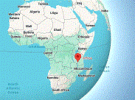
By Africa Risk Control– The Democratic Republic of Congo rarely appears in consumer markets, yet it plays a decisive role in modern technology and energy systems. From electric vehicles to smartphones and renewable energy storage, many of the products shaping the global economy depend on materials sourced from the country’s mineral belt.
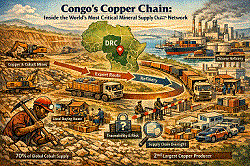
The DRC produces roughly 170,000–190,000 tons of cobalt annually – about 70 percent of global supply – along with more than 2.8–3.0 million tons of copper each year. Together, these metals form the backbone of battery manufacturing and electrification industries worldwide. As demand for clean energy technologies accelerates, the country’s importance in international supply chains continues to grow.
In practical terms, this means that industries across Asia, Europe, and North America are linked to Congolese production, often without direct commercial engagement. Many manufacturers never operate in the country but remain dependent on its output through suppliers and refiners embedded in their procurement networks.
More Than Mining
Large industrial concessions dominate production in southern regions around Kolwezi and Lubumbashi, where some of the world’s richest copper and cobalt deposits are located. These operations attract major international investors and contribute the majority of export volume. Yet extraction is only the beginning of the commercial journey.
Before reaching refineries and manufacturers, minerals typically pass through several layers of intermediaries including traders, exporters, transport operators, and inspection services. This multi-stage process effectively turns the DRC into a supply-chain hub rather than simply a mining location.
Because each stage involves a different company and jurisdiction, the commercial structure surrounding minerals can be more complex than the mining activity itself.
Distance Shapes the Market
Geography strongly influences how the sector functions. The DRC is landlocked, and mineral cargoes must travel long distances to reach international shipping routes. Most shipments move between 1,500 and 2,500 kilometers through regional corridors before export.
The main routes connect southern mining regions to ports in Tanzania, South Africa, and increasingly Angola. Along these corridors, a supporting economy has developed involving trucking fleets, storage facilities, documentation agents, and inspection providers.
For businesses, this creates opportunities well beyond extraction. Logistics providers, certification companies, engineering firms, and trading intermediaries all play roles in the delivery chain. In many cases, these services determine delivery reliability more than production levels at the mine itself.
Artisanal Mining and Market Complexity
Alongside industrial production, an estimated 150,000–200,000 artisanal miners operate in the copper-cobalt belt. Small-scale mining contributes a minority share of total output but remains an important part of the local economy.
This parallel production structure has led international buyers to increase attention on sourcing standards and traceability requirements. As supply chains become more transparent, companies purchasing minerals indirectly through traders increasingly examine how materials move through the system before export.
The result is a sector where commercial relationships extend beyond extraction agreements into logistics and verification processes.
Growing Global Demand
Demand for copper and cobalt is expected to expand significantly in the coming decade. Electric vehicles require several times more copper than traditional cars, while cobalt continues to play a role in many battery chemistries used in electronics and energy storage systems.
Because of its scale of production, the DRC is positioned to remain central to these industries. Even companies operating outside the mining sector — including manufacturers, distributors, and technology firms — often find themselves indirectly connected to the country through supplier networks.
Looking Beyond Production
While production figures explain the country’s importance, understanding how materials move from mine to market is equally essential. Transport corridors, trading relationships, and export processes play a major role in determining delivery timelines and commercial reliability.
Africa Risk Control has published a detailed operational analysis explaining how the DRC’s mineral supply chains function in practice and what businesses should consider before entering partnerships.
Read the full analysis on the Africa Risk Control platform: Congo’s Copper Chain: Inside the World’s Most Critical Mineral Supply Network
EDITOR’S NOTE– Africa Risk Control (ARC) is a due diligence and risk advisory service provider operating in dozens of African countries. Corporate Due Diligence, Risk Advisory, Country Risk Insights, Background Checks, Identity Verification (for banks, governments, and institutions), Verification for Citizenship by Investment / Donations Programs, Verification for Permanent Residency by Investment / Donation Programs, Source Wealth Verification, Competitor Intelligence, and Market Entry Research are some of the major services ARC has been providing.