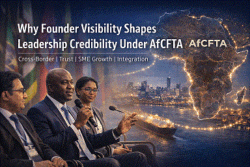
By BEHAK – As African businesses scale beyond national borders, leadership becomes increasingly visible—whether intentionally or not. Under AfCFTA, founders and senior executives are no longer assessed only by those who know them personally.
They are evaluated by partners, investors, and institutions who may have no prior relationship with the company at all. In this environment, founder visibility plays a decisive role in shaping leadership credibility. The way a founder appears publicly—through media, interviews, or industry discussions—often influences how the entire organization is perceived.
The African Continental Free Trade Area (AfCFTA) was established through an agreement signed in 2018 and officially commenced trading in January 2021. It brings together 54 African countries, making it the largest free trade area in the world by number of participating states.
AfCFTA aims to create a single continental market for goods and services, facilitate the free movement of business persons and investments, and strengthen Africa’s position in global trade by promoting intra-African commerce, industrialization, and regional value chains.
As AfCFTA expands cross-border engagement, leadership scrutiny has intensified. Partners want to understand not only what a company produces, but who leads it, how decisions are made, and whether leadership can represent the business credibly beyond its home market.
Leadership as a Proxy for Organizational Trust
In many African SMEs, the founder remains the primary decision-maker, public representative, and strategic driver. As a result, external stakeholders often treat founder credibility as a proxy for organizational reliability.
When founders are visible in credible business discussions, they signal confidence, accountability, and openness. When they are absent, questions arise—not necessarily about integrity, but about readiness for external engagement.
A Cross-Regional Leadership Scenario
Consider an agro-processing company based in Uganda, exporting value-added agricultural products to regional markets. Seeking to expand under AfCFTA, the company explores partnerships with manufacturing and packaging firms in Tunisia, a country known for its industrial base and access to Mediterranean markets.
Before formal discussions begin, Tunisian partners research the Ugandan company’s leadership. They look for interviews, conference participation, or business commentary involving the founder. If the founder has appeared in credible media discussing sector challenges, export readiness, or regional trade, it reassures partners that leadership understands cross-border expectations.
If the founder has no public presence, uncertainty grows. Partners may wonder whether leadership can navigate regulatory complexity, manage external scrutiny, or represent the company in broader forums—even if operations are sound.
Why Founder Silence Is Interpreted Carefully
Founder silence is often intentional. Many entrepreneurs prefer to focus on operations rather than public engagement. However, under AfCFTA, silence is increasingly interpreted as a lack of preparedness for regional exposure.
Partners are not looking for celebrity founders. They are looking for leaders who can articulate strategy, respond to questions, and engage confidently beyond local contexts.
Visibility Without Personal Branding Excess
Founder visibility does not require constant self-promotion. It requires selective, thoughtful engagement. Participating in industry discussions, contributing to business media, or speaking on sector trends signals seriousness rather than ego.
When done correctly, founder visibility enhances corporate credibility without overshadowing the business.
Leadership Visibility and Due Diligence
During due diligence, leadership visibility becomes particularly important. Background checks often extend to founders’ public records, statements, and affiliations. A consistent, professional public footprint reduces uncertainty and speeds evaluation.
Founders who have engaged publicly over time are easier to assess. Their thinking, values, and experience are already documented.
AfCFTA and the Rise of Pan-African Leadership Expectations
AfCFTA encourages African businesses to think continentally. Leadership expectations follow the same trajectory. Founders are increasingly expected to represent their companies across borders, cultures, and regulatory environments. Visibility prepares leaders for this role.
Credibility Is Built Before It Is Needed
Founder credibility cannot be assembled at the moment of opportunity. It is built gradually through consistent public engagement.
For African SMEs navigating AfCFTA, founder visibility is not about personal recognition. It is about leadership readiness in a regional market.
EDITOR’S NOTE: The contributor of the article, BEHAK PR Solutions is a strategic communications and public affairs advisory firm based in Addis Ababa, working with organizations operating across policy-sensitive environments in Africa. The firm supports institutions in presenting accurate, factual information about their activities to stakeholders including media, regulators, and partners.
Its work focuses on credibility-centered communication — helping organizations explain complex operations clearly, reduce misunderstandings, and strengthen institutional trust in environments where public perception can affect operational continuity.
Learn more about BEHAK PR Solutions.