By Africa Risk Control (ARC) – Ethiopia’s security landscape in 2026 is shaped less by large-scale conflict and more by localized, intermittent, and region-specific tensions that influence mobility, supply chains, community relations, and project continuity. Africa Risk Control’s (ARC) assessments show that understanding these fragmented patterns is now essential for accurate risk modeling and operational planning.
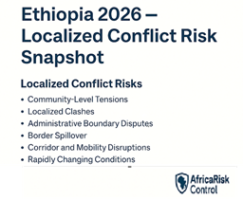
Local conflicts vary widely in intensity and frequency across regions. Some areas experience periodic community-level tensions, while others face recurring clashes linked to land issues, administrative boundaries, or political realignments. These incidents often remain underreported or mischaracterized in national-level updates, creating gaps in situational awareness for external stakeholders.
The implications for investors are significant. Localized conflicts affect how easily personnel, inputs, and equipment can move between project sites. They also influence workforce stability, contract negotiations, supply-chain reliability, and the ability of partners to meet deliverable timelines. In some cases, tensions may disrupt operations temporarily; in others, they may signal deeper shifts in local political or economic dynamics.
Ethiopia’s border regions introduce additional layers of complexity. Spillover pressures from the Sudan conflict, shifts in informal trade, and changes in local security postures shape the operating environment in adjacent districts. Even when direct clashes are absent, the administrative and operational impact can be substantial.
Sector exposure varies across these conflict patterns:
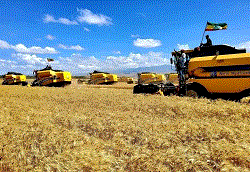
• Agribusiness: localized tensions near production areas may disrupt the movement of perishables, inputs, and harvests.
• Energy & infrastructure: projects in areas where community or boundary issues persist may experience delays, access restrictions, or elevated operational costs.
• Logistics: route planning and delivery timelines are affected by checkpoint variations, temporary closures, or rapid shifts in local security conditions.
• Manufacturing: indirect exposure arises from supply-chain delays or inconsistent workforce availability.
• NGO and humanitarian operations: high sensitivity to even small-scale conflict changes due to access requirements.
What makes these patterns challenging for organizations is their speed of change. Localized conflict conditions can shift within days—or even hours—depending on political announcements, community events, or administrative decisions. Static reports or annual analyses cannot capture these fluctuations.
ARC’s Ethiopia Country Risk & Due Diligence Report — 2026 Q1 Premium Edition integrates localized conflict monitoring into its broader assessment, backed by field reporters, local researchers, and regional desk chiefs across Ethiopia and neighboring countries. This enables organizations to understand not only where conflict risks exist, but how they intersect with political, economic, and operational realities.
As Ethiopia moves into 2026, localized conflict risk will be one of the most influential variables shaping project timelines, safety considerations, and long-term business continuity.
Request free Executive Summary
Get the full Ethiopia 2026 Premium Report
Book 1-Hour Country Intelligence Briefing with ARC Lead Researcher
EDITOR’S NOTE– Africa Risk Control (ARC) is a due diligence and risk advisory service provider operating in dozens of African countries. Corporate Due Diligence, Risk Advisory, Country Risk Insights, Background Checks, Identity Verification (for banks, governments, and institutions), Verification for Citizenship by Investment / Donations Programs, Verification for Permanent Residency by Investment / Donation Programs, Source Wealth Verification, Competitor Intelligence, and Market Entry Research are some of the major services ARC has been providing.