BY BEHAK – Understanding travel conditions in Ethiopia requires a perspective that goes beyond simple seasonal categorization. The country’s climate is shaped by a combination of altitude, regional geography, and rainfall patterns that vary significantly across relatively short distances. For visitors unfamiliar with these dynamics, Ethiopia can appear unpredictable. In practice, however, its environmental systems follow identifiable structures that influence how and when travel is most feasible.
Unlike destinations where climate can be summarized through uniform seasonal patterns, Ethiopia presents multiple climatic zones operating simultaneously. These zones are not only geographically distinct but also functionally different in terms of accessibility, visibility, and overall travel experience. As a result, timing a visit to Ethiopia is less about selecting a single optimal period and more about aligning travel plans with the specific regions and conditions involved.
Altitude and Climate Structure
One of the most defining features of Ethiopia’s climate is elevation. Much of the country’s central plateau, including Addis Ababa, lies above 2,000 meters. This elevation moderates temperatures, resulting in relatively stable daytime conditions and cooler evenings throughout much of the year.
This highland climate contrasts sharply with lowland areas such as the Danakil Depression, where temperatures regularly exceed 40°C. The variation between these zones illustrates how altitude functions as a primary determinant of climate in Ethiopia, creating environments that differ not only in temperature but also in humidity and atmospheric conditions.
Environmental analyses, including those published by the World Bank, emphasize Ethiopia’s diverse climatic zones as a central aspect of its geographic identity. For travelers, this diversity means that climate cannot be assessed at a national level alone but must be understood regionally.
Rainfall Patterns and Seasonal Cycles
Ethiopia’s seasonal structure is largely defined by rainfall rather than temperature. The main rainy season, commonly referred to as Kiremt, typically extends from June to September. During this period, highland and northern regions experience sustained rainfall, which can affect both visibility and accessibility.
In areas such as Simien Mountains National Park, the rainy season transforms the landscape, enhancing vegetation and altering the visual character of the terrain. While this creates a different type of aesthetic experience, it may also limit trekking conditions and reduce clarity for panoramic views.
The dry season, known as Bega, generally runs from October to March. This period is characterized by clearer skies, more predictable travel conditions, and improved road accessibility. It is during this time that many visitors choose to explore Ethiopia’s historical and natural sites, as conditions are more stable across most regions.
However, describing the dry season as universally optimal would be an oversimplification. Regional variations persist, particularly in areas influenced by localized weather patterns.
Regional Variation and Environmental Transitions
One of the defining aspects of travel in Ethiopia is the extent to which conditions change between regions. A journey that includes highland, lowland, and lake environments may involve transitions across entirely different climatic systems.
For instance, areas surrounding Lake Tana may experience different rainfall patterns compared to highland regions, even within the same broader season. Similarly, parts of the Rift Valley often maintain relatively stable conditions when other areas are affected by rainfall.
This variation reinforces the importance of planning travel based on specific destinations rather than relying on generalized seasonal advice. In practice, it is often possible to identify suitable travel windows for different regions at different times of the year.

Climate and Cultural Timing
Seasonality in Ethiopia is not only environmental but also cultural. Religious calendars and social practices intersect with climatic conditions, creating periods of heightened activity and significance.
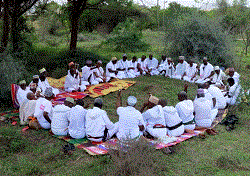
Major religious events, including Timket, take place during the dry season and attract both local participants and international visitors. These events are not structured as tourism products but as integral components of community life. Their timing reflects a combination of religious tradition and practical considerations related to climate.
From a broader tourism perspective, the relationship between climate and cultural events is increasingly recognized. Organizations such as the UN World Tourism Organization have identified cultural seasonality as a factor influencing travel patterns, particularly in destinations where heritage and tradition remain actively practiced.
Infrastructure and Accessibility
Seasonal variation also affects how infrastructure functions across Ethiopia. During the rainy season, road conditions in certain regions may deteriorate, leading to longer travel times and reduced accessibility. This is particularly relevant in rural and highland areas where road networks are more sensitive to weather conditions.
In contrast, the dry season allows for more consistent movement between destinations. Travel planning becomes more predictable, and overland routes are generally easier to navigate.
Domestic air travel provides an important alternative, particularly for connecting distant regions. Ethiopian Airlines plays a central role in maintaining connectivity across the country, enabling travelers to bypass some of the limitations associated with seasonal road conditions.
Local Services and Visitor Support
Seasonal variation influences not only environmental conditions but also the availability and operation of visitor services across Ethiopia. In urban centers such as Addis Ababa, hotels, restaurants, and transport services generally operate consistently throughout the year, providing a stable base for travelers.
In regional destinations, however, service availability may fluctuate depending on travel conditions. Areas such as Lalibela and trekking zones near Simien Mountains National Park rely on a network of local hotels, guides, tour operators, and transport providers whose operations are often aligned with seasonal demand.
Similarly, in more logistically complex destinations such as the Danakil Depression, organized tours, vehicle support, and specialized services are essential components of the visitor experience.
Understanding these service dynamics is an important part of interpreting how climate and seasonality affect travel planning across Ethiopia.
Interpreting “Best Time to Visit”
The concept of a single “best time to visit Ethiopia” is often presented in simplified travel guidance. In reality, such a definition depends on multiple variables, including destination, purpose of travel, and tolerance for environmental variation.

For visitors focused on historical sites and trekking, the dry season offers clearer conditions and greater accessibility. For those interested in landscapes and environmental transformation, the rainy season presents a different, though less predictable, experience.
Rather than identifying a fixed optimal period, it is more accurate to approach travel timing as a process of alignment—matching destinations with the conditions that best support the intended experience.
Concluding Perspective
Ethiopia’s climate is not uniform, nor does it conform to simplified seasonal models. It is shaped by altitude, regional geography, and rainfall patterns that create multiple travel environments within a single country.
For visitors, this complexity requires a more deliberate approach to planning. However, it also provides flexibility, as different regions remain accessible under different conditions throughout the year.
Understanding these dynamics allows for a more informed interpretation of travel timing, enabling visitors to navigate Ethiopia’s environmental diversity with greater clarity.
EDITOR’S NOTE: This content is provided by BEHAK Multimedia PLC, a communications and public relations firm in Ethiopia and the publisher of New Business Ethiopia. BEHAK supports businesses in enhancing visibility, credibility, and reputation while strengthening branding efforts through well researched sponsored content.
Such content may include hyperlinks to a client’s website or social media pages, offering direct access for global potential clients. By incorporating carefully researched digital content with hyperlinks to company websites and social media pages, BEHAK enables businesses to promote their services to global potential clients.
Businesses interested in enhancing their digital visibility through such well researched sponsored content are invited to reach out directly to the BEHAK Team.