By BEHAK PR Solutions – In traditional business environments, due diligence was largely a technical exercise. Analysts examined financial statements, lawyers reviewed contracts, and compliance teams verified regulatory standing. These steps remain essential, but in today’s interconnected markets they are no longer the true starting point.
In modern cross-border business, due diligence increasingly begins with media intelligence. Before engaging advisors, requesting documentation, or committing internal resources, decision-makers want a fast, credible signal of reputational risk. Media monitoring provides that signal. It answers a basic but decisive question early: Is this counterparty publicly visible, and how have they been perceived over time?
AfCFTA and the Expansion of Reputational Exposure
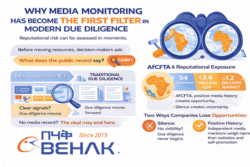
The launch of the African Continental Free Trade Area (AfCFTA) has transformed how African businesses are assessed. By integrating 54 countries into a single trade framework, AfCFTA has expanded not only commercial opportunity but also reputational exposure.
Companies are no longer evaluated solely within domestic contexts. A firm operating in one country may now be screened by partners, investors, or regulators from dozens of others—each applying their own risk thresholds and institutional expectations.
In this environment, reputation travels faster than formal documentation. Media history becomes a shared reference point across borders.
Media Monitoring as a Gatekeeper, Not a Follow-Up
Media monitoring functions as an early-stage filter. It helps investors and partners decide whether a company is worth deeper examination at all.
Reviewers are not simply looking for scandals. They assess patterns over time:
-
Has the company appeared consistently in credible business or sector coverage?
-
Are there unresolved disputes, regulatory conflicts, or contradictory narratives?
-
Does leadership demonstrate continuity and accountability in public records?
A stable media footprint signals operational maturity. A volatile or opaque one raises immediate caution.
In many cases, this screening determines whether formal due diligence proceeds or quietly ends.
A Common AfCFTA-Era Scenario
Consider a regional investor evaluating a potential logistics partner operating in East Africa. Before commissioning financial or legal reviews, analysts conduct a reputational scan.
They search for independent media references related to the company, its executives, and its operational history. Coverage that reflects normal business activity, industry engagement, or policy interaction suggests legitimacy and experience. Silence, fragmented mentions, or unresolved negative stories introduce uncertainty.
That uncertainty often stops the process early—not because wrongdoing is proven, but because risk cannot be efficiently assessed.
This approach is no longer exceptional. It is standard practice.
Why Owned Visibility Is Not Enough
Many companies assume that credibility accumulates through self-managed channels: company websites, social media activity, online directories, or marketing materials.
While these assets matter for branding, they carry limited weight in due diligence. Reviewers understand that owned platforms are controlled narratives.
Independent media coverage, by contrast, represents third-party validation. It indicates that an external actor—editor, journalist, or publication—considered the company relevant enough to reference publicly.
One credible media mention often carries more reputational value than multiple self-published assets. It signals exposure to public scrutiny rather than controlled promotion.
The Risk of Silence in Competitive Markets
A lack of media presence is not inherently negative. However, in competitive AfCFTA markets, silence creates friction.
When no independent references exist, reviewers must rely entirely on self-reported information. That increases the time, cost, and uncertainty of assessment.
Given abundant alternatives, decision-makers often choose easier paths. Companies with no visible public record are frequently excluded without explanation—not because they failed due diligence, but because they never passed the first filter.
Positive Media History as Risk Buffer
Companies with established media histories benefit from reputational buffering. Prior coverage suggests continuity, accountability, and operational exposure over time.
This does not eliminate risk, nor does it replace formal checks. But it reduces perceived uncertainty. It allows internal teams to justify proceeding, allocating resources, and advancing discussions.
In fast-moving environments, that reduction in friction matters.
Media Monitoring Beyond Crisis Management
Media monitoring is often associated with crisis response. In reality, its strategic value lies in opportunity readiness.
Reputation accumulates quietly. When opportunities arise, companies with consistent public records appear prepared and credible. Those without appear untested, regardless of their actual capacity.
In AfCFTA’s accelerated deal environment, readiness is decisive.
Reputation Is Revealed, Not Built, During Due Diligence
Due diligence does not create reputation. It reveals what already exists.
Organizations that invest in credible visibility and long-term media engagement enter cross-border markets with a structural advantage. They are easier to assess, easier to trust, and easier to approve.
In today’s risk-aware business climate, media intelligence is no longer a supporting tool. It is the starting line.
EDITOR’S NOTE:
BEHAK PR Solutions is an Africa-focused strategic communications and public relations firm headquartered in Addis Ababa, Ethiopia and publisher of New Business Ethiopia. Established in 2019 by veteran journalists, the firm delivers public relations services grounded in credibility, media intelligence, and a deep understanding of Africa’s political, institutional, and media landscapes.
BEHAK’s work spans five core service areas: Strategic Communication & Advisory, Media Relations & Publicity, Crisis Management & Response, Digital PR & Content Marketing, and Event Management & Measurement, supporting organizations seeking to build trust, manage reputation, and engage effectively with regional and global audiences.