By Africa Risk Control – South Africa occupies a unique position in Africa’s economic and investment landscape. It is the continent’s most industrialized economy, home to deep capital markets, globally integrated mining operations, and a sophisticated corporate ecosystem.
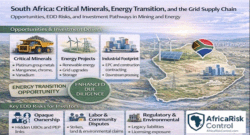
Today, however, the country is being re-evaluated through a new lens: its central role in the global energy transition and critical minerals supply chain. Platinum group metals, manganese, chrome, and vanadium—resources in which South Africa holds a commanding global position—are increasingly essential to clean energy technologies, battery storage, and industrial decarbonization. At the same time, the country’s prolonged electricity crisis has forced structural reforms in energy generation and procurement, opening new entry points for private capital.
For investors, contractors, and suppliers, this convergence of resource wealth and reform has created genuine opportunity. But it has also intensified scrutiny. In South Africa’s current environment, success depends not only on identifying opportunity, but on navigating risk with discipline.
A Market Shaped by Energy Constraints and Reform
Over the past five years, South Africa’s economy has been constrained by persistent electricity shortages, logistics bottlenecks, and fiscal pressure. Load shedding has disrupted industrial output, reduced productivity, and raised operating costs across sectors. These constraints have weighed on growth and investor sentiment.
In response, the government has accelerated reforms aimed at liberalizing electricity generation and transmission. Licensing thresholds for private power generation have been raised, allowing companies to develop their own renewable energy projects without lengthy approval processes. This has triggered a surge of investment in solar, wind, and hybrid energy solutions, particularly for mining operations and energy-intensive industries.
As a result, the energy value chain—generation, transmission, grid services, and storage—has become one of South Africa’s most active investment arenas.
Critical Minerals at the Center of Global Demand
South Africa’s mining sector remains the backbone of its global relevance. The country dominates global production of platinum group metals, which are essential for catalytic converters, hydrogen technologies, and fuel cells. It is also a major producer of manganese and chrome, critical inputs for steelmaking and battery technology.
Global demand for these minerals has remained resilient, driven by decarbonization commitments in Europe, North America, and Asia. This has sustained export revenues even as domestic constraints affected production volumes.
However, mining investment today is no longer evaluated solely on resource quality. Investors increasingly assess governance, environmental compliance, labor relations, and community engagement. South Africa’s long history of mining has produced both deep expertise and complex legacies—particularly around land access, rehabilitation obligations, and social license to operate.
Opportunity Comes with Institutional Complexity
One of South Africa’s defining characteristics is institutional density. Mining and energy projects intersect with national regulators, state-owned enterprises, provincial authorities, labor unions, and local communities. Each layer introduces both oversight and risk.
Labor relations, in particular, remain a critical variable. Strikes and wage disputes have historically disrupted mining output and investor confidence. Community protests over land use, employment, and environmental impact can delay projects and escalate into legal disputes.
For new entrants, understanding these dynamics is as important as understanding the technical scope of a project. Misreading institutional behavior can lead to delays, cost overruns, or reputational damage.
Procurement, Partnerships, and Where Deals Go Wrong
Most foreign investors and suppliers enter South Africa’s mining and energy sectors through partnerships, joint ventures, EPC contracts, or vendor frameworks. On paper, these structures appear robust. In practice, risk often emerges during execution.
Common challenges include:
• Unclear ownership structures within partner companies
• Disputes over subcontracting and cost allocation
• Delays linked to regulatory or labor issues
• Legacy environmental liabilities that surface post-acquisition
In many cases, problems are not apparent at the outset. They emerge after capital has been committed and exposure has increased. This is why investors are placing greater emphasis on upfront partner assessment and continuous risk monitoring.
ESG Scrutiny Is Now Commercial Reality
Environmental, social, and governance (ESG) considerations are no longer peripheral in South Africa. They are central to project viability.
International financiers, development banks, and institutional investors increasingly require evidence of compliance with environmental standards, community engagement frameworks, and transparent governance structures. Companies that cannot demonstrate alignment face higher financing costs—or exclusion altogether.
This has raised the bar for counterparties across the value chain. Suppliers, contractors, and service providers are now assessed not only on price and capability, but on governance maturity and reputational standing.
Why Credibility Determines Access to Capital
In South Africa’s current cycle, credibility has become a form of currency. Companies with transparent ownership, verifiable track records, and consistent public presence are easier to engage, finance, and defend internally.
Those without such attributes face longer approval processes, tougher negotiations, and greater skepticism. This dynamic applies equally to local firms seeking foreign partners and international companies entering the market.
As investment decisions become more centralized and compliance-driven, informal assurances carry less weight. Independent validation—through regulatory records, litigation history, and public references—has become decisive.
Lessons for African and International Businesses
South Africa’s experience reflects a broader African trend. As markets integrate and capital becomes more selective, the tolerance for ambiguity decreases. Investors have more options across the continent and beyond. They gravitate toward environments where risk is understood and manageable.
For African companies, participation in South Africa’s energy and mining value chains offers scale and visibility. But it also requires readiness—organizationally, institutionally, and reputationally.
For international firms, South Africa remains a gateway market. Its infrastructure, skills base, and resource endowment are unmatched. Yet the pathway to success runs through governance and risk management as much as engineering and finance.
A Market That Rewards Preparation
South Africa’s energy transition and critical minerals landscape offers significant opportunity. But it is not a market for shortcuts. The projects that succeed are those backed by disciplined planning, strong partners, and realistic assessments of institutional behavior.
As the global energy transition accelerates, South Africa’s relevance will only increase. Those who engage with the market thoughtfully—recognizing both its potential and its complexity—will be best positioned to benefit.
EDITOR’S NOTE– Africa Risk Control (ARC) is a due diligence and risk advisory service provider operating in dozens of African countries. Corporate Due Diligence, Risk Advisory, Country Risk Insights, Background Checks, Identity Verification (for banks, governments, and institutions), Verification for Citizenship by Investment / Donations Programs, Verification for Permanent Residency by Investment / Donation Programs, Source Wealth Verification, Competitor Intelligence, and Market Entry Research are some of the major services ARC has been providing.