As African markets become more integrated under the African Continental Free Trade Area (AfCFTA), small and medium enterprises (SMEs) are increasingly looking beyond their home countries for distributors, agents, and strategic partners. Many approach this process with confidence in their products and services, assuming that competitive pricing or operational capability will be sufficient to secure cross-border relationships.
The African Continental Free Trade Area (AfCFTA) was established through an agreement signed in 2018 and officially commenced trading in January 2021. It brings together 54 African countries, making it the largest free trade area in the world by number of participating states. AfCFTA aims to create a single continental market for goods and services, facilitate the free movement of business persons and investments, and strengthen Africa’s position in global trade by promoting intra-African commerce, industrialization, and regional value chains.
In practice, however, most partnership discussions never reach the stage where price or logistics are discussed. They end quietly, often without explanation. The decisive factor is frequently reputation.
Reputation Comes Before Engagement
Cross-border partnerships expose both parties to shared commercial and reputational risk. Distributors and partners are cautious by design. Before committing resources, they seek confidence that the company they are considering is legitimate, reliable, and capable of operating beyond its domestic environment.
This assessment rarely begins with formal requests. It begins with reputational signals — what is publicly known, what can be independently verified, and how the business appears in broader market conversations.
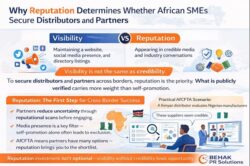
Many SMEs assume that visibility is cumulative—that appearing on multiple business directories, maintaining a company website, or having an active social media presence creates credibility. In practice, these forms of visibility carry limited weight in reputational assessment.
A single press release, interview, or feature published by a credible, independent media outlet often has far greater impact than ten directory listings or a well-designed website. This is because media coverage represents third-party validation. It signals that the business has been assessed, referenced, and deemed relevant by an external actor rather than simply promoting itself.
A Practical AfCFTA Scenario
Imagine a consumer-goods distributor based in Kenya exploring suppliers under AfCFTA from Nigeria. The distributor receives proposals from several Nigerian manufacturers offering similar pricing and delivery terms. Before responding, the distributor conducts basic background checks.
The first step is not a factory audit, but a reputational scan — searching for business media mentions, industry commentary, and public references to the companies and their leadership.
Manufacturers that appear in credible Nigerian or regional African business media are shortlisted more quickly. Their visibility signals operational seriousness and market engagement. Those that exist only through their own websites and social media pages are not necessarily rejected outright, but they are deprioritized. The distributor moves forward with suppliers that appear easier to verify and defend internally.
This scenario plays out repeatedly across AfCFTA markets.
Reputation as a Risk-Reduction Tool
From a partner’s perspective, reputation reduces uncertainty. It shortens the time needed to assess credibility and lowers the perceived risk of engagement. A company with a visible, consistent public footprint requires fewer explanations and generates fewer internal objections.
This matters because AfCFTA expands choice. Partners can evaluate options across multiple countries. As options increase, tolerance for ambiguity decreases.
Why Invisible SMEs Lose Opportunities Quietly
Many SMEs believe that if a partner is interested, discussions will naturally progress. What they often fail to see is that elimination occurs early and silently. Companies without visible reputational signals are filtered out before engagement begins.
They are not rejected on merit. They are excluded on uncertainty.
Media Presence as External Validation
Reputation is strongest when it is reinforced externally. Independent media coverage provides third-party validation that a company is active, relevant, and accountable. It shows that the business has been visible to public scrutiny and has participated in broader industry conversations.
In cross-border contexts, where partners may lack local familiarity, this validation becomes especially important.
Reputation Must Exist Before It Is Needed
A common mistake SMEs make is attempting to build reputation only once partnership opportunities arise. By then, it is too late. Reputation cannot be accelerated to meet commercial timelines.
SMEs that invest early in visibility and credibility move more efficiently under AfCFTA. They spend less time proving legitimacy and more time negotiating terms.
AfCFTA Rewards Trusted Businesses
AfCFTA does not reward ambition alone. It rewards businesses that are trusted across borders.
For African SMEs seeking distributors and partners, reputation is no longer abstract. It is a practical requirement for participation in regional trade.