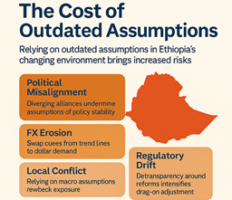
By Africa Risk Control – Ethiopia’s 2026 investment landscape is evolving more rapidly than many external observers realize. Assumptions shaped by the period between 2020 and 2023 — whether relating to political trends, security outlooks, FX availability, or regulatory predictability — no longer hold consistently across the country.
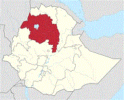
Africa Risk Control’s (ARC) field intelligence indicates that relying on outdated assumptions is now one of the biggest risks facing investors entering or expanding in Ethiopia. One of the key challenges is the shifting relationship between federal and regional administrations.
National policies may outline reform objectives, but the pace and reliability of implementation depend heavily on local governance dynamics. Regions vary in how consistently they apply regulations, manage licensing requests, or enforce compliance. Investors basing decisions on historical expectations may encounter delays, unexpected administrative barriers, or inconsistencies that affect operational planning.
Security conditions present a second major area where assumptions must be revisited. Although Ethiopia has moved away from large-scale nationwide conflict, localized tensions remain a significant factor. These include community-level disputes, sporadic clashes, mobility restrictions, and evolving security responses. ARC’s assessments emphasize that these patterns are not static; they shift based on political developments, local grievances, border-area pressures, and economic conditions. Organizations relying solely on national-level stability indicators may underestimate the operational impact on supply chains, staffing, and project continuity.
FX availability adds another layer of volatility. Ethiopia’s foreign currency shortages continue to affect import-dependent sectors such as manufacturing, construction, agribusiness, and logistics. Even organizations with strong business fundamentals may face rising costs, procurement delays, or pricing unpredictability. ARC’s field data suggests that firms planning around outdated FX assumptions risk underestimating working-capital needs and overestimating project feasibility.
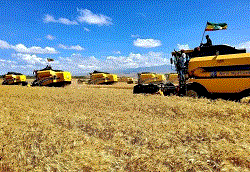
Sector exposure further demonstrates the importance of updated assumptions. Opportunities remain strong in areas such as renewable energy, agribusiness, ICT, digital payments, and logistics. However, each sector faces localized risks tied to security, regulatory clarity, administrative behavior, and infrastructure reliability. National-level optimism does not always reflect regional realities.
ARC’s Ethiopia Country Risk & Due Diligence Report — 2026 Q1 Premium Edition provides a forward-looking, region-specific, and sector-sensitive framework that helps investors avoid planning based on outdated assumptions. The report outlines political scenarios, regional vulnerabilities, conflict hotspots, supply-chain risks, FX exposure, governance concerns, and operational requirements.
Organizations preparing for 2026 must recalibrate their assumptions to match Ethiopia’s current realities. The cost of getting Ethiopia wrong — through delayed projects, partner misalignment, compliance gaps, or operational disruption — is significantly higher today than in previous years.
EDITOR’S NOTE: Africa Risk Control (ARC) is launched by a group of award winning business & investigative journalist and due diligence experts in Africa to help global investors, corporations, and institutions make confident decisions in Africa’s dynamic markets.
Unlike traditional consultancies, ARC is powered by a network of investigative and business journalists in dozens of African countries. With boots on the ground, Africa Risk Control uncovers realities beyond desk research — from hidden ownership structures to political exposure, regulatory shifts, and reputational risks.