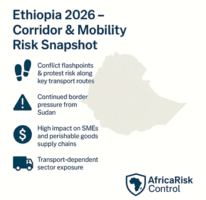
Mobility and corridor stability have become central to Ethiopia’s risk environment as the country approaches 2026. While national indicators often highlight overall improvements or challenges, Africa Risk Control’s (ARC) field intelligence repot shows that the real operational exposure lies in the variability of key transport routes, border-linked corridors, and local movement patterns across regions.
One of the most significant developments is the growing unpredictability of cross-regional movement. Localized clashes, community-level tensions, and intermittent security operations continue to disrupt mobility in select areas, affecting project sites, supply chains, and field operations. These disruptions rarely appear in official reporting but are critical to understanding real operating conditions.
In regions bordering Sudan, mobility risk is influenced by spillover pressures from the ongoing conflict, including population movement, informal trade fluctuations, and heightened security presence. These dynamics can affect humanitarian logistics, trade flows, and the stability of adjacent districts. For investors in agribusiness, logistics, construction, and energy, such corridor disruptions may result in delays, rerouting costs, and heightened operational expenditure.
Subnational political dynamics also shape mobility risk. Differences in administrative controls, security protocols, and local governance affect how easily teams, goods, and equipment can move across regional boundaries. In some areas, transport corridors remain stable; in others, checkpoints, documentation inconsistencies, or temporary closures may slow operations.
Sector exposure varies significantly:
• Logistics and transport companies remain directly vulnerable to corridor disruptions, affecting service reliability and cost structures.
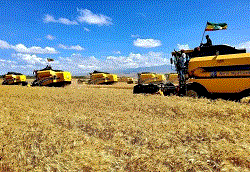
• Agribusiness operations depend on moving inputs and harvests between regions, making mobility planning essential during peak production periods.
• Energy and infrastructure projects face challenges transporting technical equipment, construction materials, and field teams through areas with shifting security conditions.
• Manufacturers relying on imported inputs may experience extended delays when overland transport links are restricted or unpredictable.
ARC’s Ethiopia Country Risk & Due Diligence Report — 2026 Q1 Premium Edition includes a comprehensive assessment of mobility risk, incorporating field reporting, corridor-level mapping, and region-specific indicators. The report highlights which areas show stable operating windows, where volatility is rising, and what investors should consider when planning deployments, supply chains, or regional logistics.
As Ethiopia enters a critical period in 2026, understanding corridor and mobility dynamics is not simply an operational necessity — it is a strategic requirement. Organizations that integrate mobility risk into their planning processes will be better positioned to protect timelines, manage costs, and maintain business continuity.
Launched in mid 2025 with boots-on-the ground in 32 plus African countries and networks of award-winning business and investigative journalists, ARC has been engaged in investment risk advisory services, and production of exclusive risk reports.
The company in its mission statement stated that it is dedicated to build investor confidence in Africa by delivering rigorous due diligence and actionable intelligence that connects global investors with trustworthy local partners, driving sustainable growth and impact across the continent.