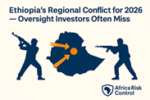
Africa Risk Control (ARC) has issued a new advisory urging investors to reassess assumptions built during earlier phases of Ethiopia’s political and economic landscape. According to ARC, many of the variables shaping the country’s 2026 outlook have shifted, creating gaps between investor expectations and on-the-ground realities.
ARC’s Ethiopia Country Risk & Due Diligence Report — 2026 Q1 Premium Edition is designed to correct these gaps. Built from field reporting across Ethiopia and supported by our network in 32 African countries, it provides a realistic, forward-looking intelligence base for risk mitigation and strategic planning.
The cost of misreading Ethiopia is rising. Decisions made on outdated intelligence lead to:
• Over-optimistic feasibility assessments
• Under-estimation of regional exposure
• Pricing or budgeting errors
• Incorrect assumptions around supply-chain reliability
• Weak partner selection
• Avoidable financial and reputational losses
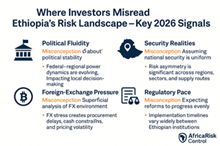
ARC notes that political alignments across federal and regional structures continue to evolve, influencing administrative decisions, regulatory implementation, and investment approvals. ARC states that relying on conditions from 2021–2023 may lead companies to underestimate new governance dynamics that affect operations.
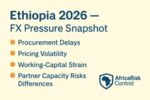
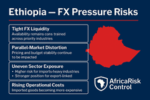
Economic pressures remain a significant factor as well, especially the ongoing foreign-exchange shortage. ARC highlights that while investors may be aware of FX constraints, many underestimate the practical implications, including delays in import procurement, working-capital disruptions, and challenges in maintaining production flow.
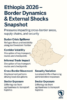
Security developments also play a central role. Although national-level conflict has eased in several regions, district-level tensions, mobility restrictions, and border-area pressures persist. These localized issues directly influence logistics, staffing, and project timelines — often with limited visibility for external observers.
ARC stresses that the combination of political, economic, and security shifts requires updated due-diligence frameworks for organizations preparing to invest or expand in Ethiopia. The firm’s Ethiopia 2026 Premium Report provides detailed guidance on risk variation across sectors and regions.
Relying on outdated assessments increases exposure and weakens project viability. That’s why ARC’s 2026 Premium Report provides updated, on-the-ground intelligence for investors, DFIs, law firms, and operators.
Request free Summary: info@africariskcontrol.com
Get the full report
Book consultation
Africa Risk Control (ARC) is launched by a group of award winning business & investigative journalist and due diligence experts in Africa to help global investors, corporations, and institutions make confident decisions in Africa’s dynamic markets.
Unlike traditional consultancies, ARC is powered by a network of investigative and business journalists in 32+ African countries. With boots on the ground, Africa Risk Control uncovers realities beyond desk research — from hidden ownership structures to political exposure, regulatory shifts, and reputational risks.