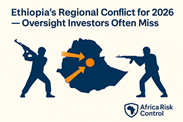
Africa Risk Control (ARC) has cautioned that many investors preparing for opportunities in Ethiopia in 2026 are relying on outdated or overly narrow indicators that no longer reflect the country’s rapidly evolving realities. According to ARC, risk levels across Ethiopia are now shaped less by national-level trends and more by localized political, security, and administrative dynamics — especially in regions experiencing heightened contestation.
ARC’s latest analysis shows that organizations placing heavy emphasis on federal political messaging risk overlooking subnational shifts that significantly influence business conditions. These include variations in district-level governance, emerging local alliances, and uneven administrative implementation — all of which can alter investment approvals, timelines, and project access.
A major oversight involves the interpretation of macroeconomic signals. While Ethiopia continues to promote reforms and investment-led policies, ARC warns that FX shortages are increasingly intertwined with regional instability, affecting procurement cycles, supplier reliability, and cash-flow planning for import-dependent industries.
ARC also highlights persistent gaps in standard security assessments. Its field intelligence teams report micro-level variations in mobility, community tensions, and corridor reliability, particularly in regions where the relationship between local armed groups and federal authorities remains fluid. Although these dynamics rarely appear in mainstream reporting, they have direct implications for logistics, staff movement, and operational continuity.
Another blind spot is partner-related exposure. ARC notes that companies often assume documentation provided by local partners reflects operating reality, yet discrepancies frequently arise involving informal networks, hidden financial pressures, and political affiliations. These patterns, ARC emphasizes, cannot be detected through surface-level due diligence.
ARC concludes that addressing these oversights is critical for investors seeking realistic planning assumptions for 2026. With Ethiopia’s risk landscape becoming increasingly asymmetrical across regions and sectors, the organization stresses the need for granular, district-level intelligence and enhanced due diligence rather than broad national indicators.
Africa Risk Control is launched by a group of award winning business & investigative journalists and due diligence experts in Africa to help global investors, corporations, and institutions make confident decisions in Africa’s dynamic markets.
Request the free Executive Summary: info@africariskcontrol.com
Get the full report
Book a 20-minute consultation