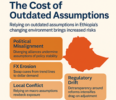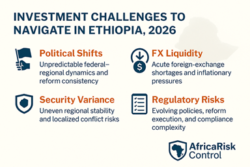
By Africa Risk Control – Ethiopia’s business environment in 2026 will be defined not only by national trends, but by increasingly visible region-level differences in political dynamics, mobility conditions, administrative predictability, and security realities. Africa Risk Control’s (ARC) field-based intelligence shows that these regional variations are among the most important factors investors must evaluate before committing capital in the year ahead.
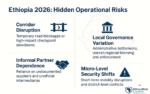
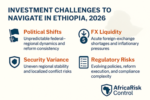
While Ethiopia continues to position itself as a large, high-potential market, the realities on the ground differ sharply between regions. Some areas show relative institutional stability, improving administrative behavior, and predictable licensing processes. Others face intermittent tensions, shifts in local leadership structures, or variable enforcement of regulations. These differences directly affect market-entry timelines, partnership reliability, and operational planning.
Security conditions also vary widely. Localized conflicts — including community-level tensions, land disputes, mobility restrictions, and periodic clashes — may affect certain districts while neighboring areas remain fully stable. ARC’s assessments across 2025–2026 show that even short-lived disruptions can influence supply-chain reliability, staff movement, and project continuity. Relying solely on national indicators obscures these region-specific realities.
Economic exposure follows the same pattern. In some regions, businesses cite consistent access to labor and market linkages; in others, they report unexpected costs linked to informal checkpoints, fluctuating route accessibility, or delays associated with security operations. These variations have a tangible impact on project feasibility, especially for logistics, agribusiness, construction, and energy.
FX-related challenges also manifest differently across regions. Although FX shortages are national in scope, the operational effects differ depending on the sector concentration, reliance on imported inputs, and resilience of local supply chains. ARC notes that investors who map their risk exposure region-by-region are better able to predict cost implications and avoid unexpected procurement delays.
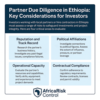
Regulatory practice is another area where regional differences matter. Ethiopia’s economic reforms continue, but the speed and consistency of regulatory implementation vary across local jurisdictions. Some regional institutions apply rules predictably, while others show inconsistencies that can affect licensing, compliance, tax issues, and partner vetting.
Given these variations, Ethiopia’s 2026 landscape requires more than a national-level assessment. Investors must evaluate region-level political shifts, operational conditions, local governance behavior, and security dynamics to understand where opportunities are viable — and where additional caution is required.
ARC’s Ethiopia Country Risk & Due Diligence Report — 2026 Q1 Premium Edition provides this granular visibility through region-level mapping, scenario forecasts, conflict hotspot analysis, and sector-specific risk exposure.
EDITOR’S NOTE– Africa Risk Control (ARC) is a due diligence and risk advisory service provider operating in dozens of African countries. Corporate Due Diligence, Risk Advisory, Country Risk Insights, Background Checks, Identity Verification (for banks, governments, and institutions), Verification for Citizenship by Investment / Donations Programs, Verification for Permanent Residency by Investment / Donation Programs, Source Wealth Verification, Competitor Intelligence, and Market Entry Research are some of the major services ARC has been providing.