By Africa Risk Control – Ethiopia’s 2026 risk landscape is shaped by a blend of political realignments, FX shortages, localized conflict patterns, and operational inconsistencies that require investors to adopt a more dynamic risk framework. Africa Risk Control’s (ARC) field intelligence across the country shows that several pressure points will define project feasibility and partnership reliability in the year ahead.
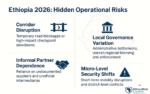
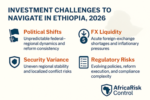
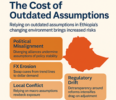
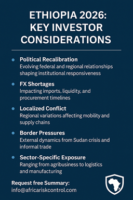
Political recalibration remains a central factor influencing institutional behavior. The evolving relationship between federal and regional authorities continues to shape licensing processes, administrative decisions, and the predictability of local governance. Investors depending on assumptions drawn from 2021–2023 may misjudge timelines, influence structures, or regulatory consistency.
FX stress remains one of the most significant operational constraints. Businesses relying on imported inputs are exposed to rising procurement delays, increased costs, and liquidity pressures. ARC’s assessments show that FX shortages now intersect with governance issues, as some entities resort to informal financing or workaround arrangements, increasing reputational and compliance risk.
Localized conflict dynamics further complicate the operating environment. While national-level indicators may suggest stability, the reality on the ground is uneven. Periodic tensions, land-related disputes, community-driven conflicts, and fluctuating security postures affect mobility, supply chains, and staff movement. These regional variations determine whether project timelines remain feasible or experience unexpected disruption.
Border and external pressures—especially from the Sudan crisis—play an additional role in shaping risk. Informal trade flows, displacement patterns, and tightened security controls influence the reliability of border-linked corridors. For sectors such as agribusiness, logistics, and manufacturing, even minor disruptions can alter cost structures and affect operational continuity.
Sector-specific exposure adds to the complexity:
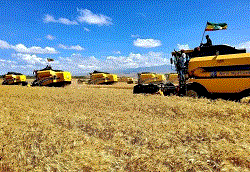
• Agribusiness is affected by corridor volatility and community tensions.
• Energy and infrastructure depend on land access, regulatory clarity, and stable local governance.
• Logistics face dynamic route conditions linked to security operations.
• Manufacturing contends with FX delays and input shortages.
In this environment, Ethiopia remains a high-potential market—but one where outdated assumptions carry increasing operational and financial risk. ARC’s Ethiopia Country Risk & Due Diligence Report — 2026 Q1 Premium Edition provides investors with a forward-looking assessment of these dynamics, supported by field verification, region-level insights, and sector-specific risk mapping.
To navigate 2026 effectively, investors must combine traditional due diligence with continuous intelligence, enabling early detection of disruptions, governance issues, and operational changes.
- Request free Executive Summary
- Get the full 107-page Ethiopia 2026 Premium Report
- Book 1-Hour Country Intelligence Briefing with ARC Lead Researcher
EDITOR’S NOTE: Africa Risk Control (ARC) is a due diligence and risk advisory service provider operating in dozens of African countries. Corporate Due Diligence, Risk Advisory, Country Risk Insights, Background Checks, Identity Verification (for banks, governments, and institutions), Verification for Citizenship by Investment / Donations Programs, Verification for Permanent Residency by Investment / Donation Programs, Source Wealth Verification, Competitor Intelligence, and Market Entry Research are some of the major services ARC has been providing.