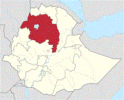
By Andualem Sisay Gessesse – As Ethiopia aims to conduct its general election in the middle of the ongoing internal deadly clashes within mainly Amhara and Oromia regions with armed groups such as, Amhara Fano and Oromo Liberation Front (OLA), understanding the current complexity from inside sources will be mandatory for any foreign investor or an NGO exploring opportunities in the east African country.
In addition to internal politics that directly affects business and investments, regional conflicts such as, the bloody war in the neighboring Sudan where many foreign actors are involved, also will have impact in business operations in Ethiopia. The likelihood of another round of war with neighboring Eritrea and with the half of Tigray Peoples Liberation Front (TPLF) in 2026 along with the pressure from Egypt that is encircling the country with military presence in the neighboring Somalia and Djibouti are also expected to impact investments and operations in Ethiopia in one way or another.
All these ongoing factors and other dynamics call for foreign investors or non-profit entities operating in Ethiopia or planning to enter the country to carefully conduct due diligence and risk advisory from professionals with boots on the ground like Africa Risk Control (ARC). That is why ARC has just released its Ethiopia Micro Risk Brief Q12026, which is an extract from the ARC’s Ethiopia Country Risk & Due Diligence Report — 2026 Q1 Premium Edition, produced based on the requests from global clients with investment and geopolitics interest in East Africa region.
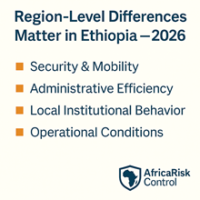
Ethiopia’s complexity requires a fundamentally different approach to risk assessment. Too many investors still treat the country as a uniform operating environment, relying on national-level summaries or broad international reporting. However, Africa Risk Control’s field-based intelligence shows that Ethiopia’s 2026 landscape can only be understood accurately through region-level analysis.
Political dynamics, administrative efficiency, mobility risks, and security conditions differ widely between regions. Moreover, these differences shift over time, and sometimes rapidly. Relying on national-level assumptions results in misinformed decisions, unrealistic timelines, or operational bottlenecks that could have been avoided through localized due diligence.
One of the clearest examples is the variation in administrative processes. Licensing, approvals, regulatory compliance, and documentation standards do not move at the same pace across regional bureaus and district-level offices. A sector that operates smoothly in one region may face delays or higher documentation requirements in another. These differences cannot be captured through national-level policy documents alone—they require real insight into local administrative behavior and institutional capacity.
Security exposure also varies significantly. Some regions show signs of stabilization, with improved mobility and predictable patterns of activity. Others continue to face localized disruptions, periodic flare-ups, or corridor-specific risks that affect supply chains. ARC’s intelligence network monitors these developments in real time, providing clients with clarity on which routes, districts, or clusters may face elevated risk exposure.
Economic conditions also differ regionally. Access to inputs, labor availability, price stability, and FX exposure depend partly on a company’s geographic footprint. A logistics operator serving cross-regional routes faces different challenges than a company operating within a single corridor. Similarly, agribusiness, manufacturing, and energy projects each face location-specific constraints or opportunities.
Investor engagement often hinges on choosing the right partners—and partner quality also varies across regions. ARC’s due diligence investigations frequently uncover governance issues, financial opacity, or reputational risks that would not be visible through basic document checks. Understanding a partner’s regional influence, reliability, and past performance is crucial for long-term viability.
Region-level analysis is not optional—it is essential for accurate risk management. Ethiopia’s diversity means that assumptions must be localized, verified, and continually updated. ARC’s Ethiopia Country Risk & Due Diligence Report — 2026 Q1 Premium Edition with one hour Intelligence briefing call breaks down risk exposure across regions, mapping security patterns, administrative realities, mobility challenges, and FX-linked operational factors with field-verified intelligence.
For organizations entering Ethiopia in 2026, regional clarity is not just a competitive advantage—it is a safeguard for capital, reputation, and operational continuity.
Launched by Award-winning investigative and business journalists from various African countries, ARC unlike traditional consultancies is powered by a network of investigative and business journalists in 32+ African countries with a of mission of building investor confidence in Africa. With boots on the ground, ARC uncovers realities beyond desk research — from hidden ownership structures to political exposure, regulatory shifts, and reputational risks.