By BEHAK – In the era of the African Continental Free Trade Area (AfCFTA), distributors have become the quiet arbiters of cross-border success. While manufacturers focus on production capacity and pricing, distributors focus on something less visible but equally decisive: reputational risk.
AfCFTA has expanded the African marketplace into a single continental framework. It has widened opportunity for suppliers, but it has also widened exposure for distributors. A distributor operating in Southern Africa can now assess suppliers from West, Central, or East Africa within minutes. The increase in options has raised the threshold for trust.
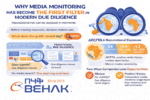
Before any commercial negotiation begins, distributors conduct an informal but highly consequential review. They search for public information. They examine media coverage. They assess whether a company has demonstrated regulatory compliance, export readiness, leadership visibility, and operational continuity. This early-stage screening does not replace formal due diligence; it determines whether due diligence is justified.
Distribution is inherently reputation-leveraged. When a distributor represents a supplier, it attaches its own credibility to that partnership. If the supplier fails to meet standards—whether through regulatory breaches, delivery disruptions, or governance concerns—the reputational consequences extend beyond the manufacturer. The distributor’s judgment is questioned. For this reason, distributors are cautious long before contracts are drafted.
Consider a regional distributor based in Angola evaluating agribusiness suppliers from Cameroon. The Cameroonian firms may have strong production capacity and competitive pricing. Yet the Angolan executives first examine something else: public footprint. Has the company appeared in credible African business publications? Has it participated in trade forums? Are there references to export compliance, certifications, or partnerships? Even limited but substantive media coverage signals institutional maturity. It suggests that the company has operated under scrutiny and understands external accountability.
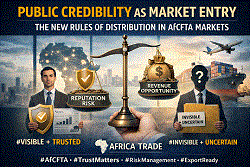
In contrast, a supplier with no visible record creates uncertainty. The absence of information does not imply wrongdoing, but it introduces opacity. In competitive AfCFTA corridors, opacity slows decisions. When multiple alternatives exist, distributors gravitate toward suppliers whose credibility can be externally referenced.
Media visibility functions as a form of commercial shorthand. It reduces information asymmetry in the earliest phase of evaluation. Distributors cannot conduct deep investigations into every prospective partner. Public signals allow them to narrow their focus. Companies that appear in independent media benefit from a subtle but powerful form of third-party validation.
This dynamic also influences internal governance within distribution firms. Supplier selection often requires approval from executive committees or boards. When managers can reference credible media coverage, their recommendations appear more defensible. The presence of independent reporting strengthens internal justification and accelerates decision-making. Without that reference point, proposals face greater scrutiny and delay.
AfCFTA has intensified supplier competition across borders. Price and product quality remain essential, but credibility has emerged as a differentiator. In a marketplace defined by integration and transparency, invisibility carries commercial cost. Distributors rarely reject suppliers because of negative media alone; they often bypass suppliers because no information exists at all.
For African small and medium enterprises seeking regional expansion, this reality requires adjustment. Media engagement is not simply promotional activity. It is part of market preparation. Appearing in credible business publications, demonstrating regulatory milestones publicly, and communicating operational achievements signal stability and readiness. These signals shape perception before first contact is made.
Under AfCFTA, trust is increasingly constructed in public before it is confirmed in private. Distributors decide who to engage based on what they can verify externally. In this environment, credibility precedes commerce, and visibility often determines access.
EDITOR”S NOTE: BEHAK, an Africa-based strategic communications and media advisory firm headquartered in Addis Ababa, works with NGOs, development agencies, and mission-driven enterprises to strengthen credible media visibility across African and international platforms.
Through structured media engagement, narrative development, leadership profiling, and policy-focused communication strategy, BEHAK enables organizations to translate complex field operations into clear, defensible public narratives. Its approach prioritizes accuracy, institutional maturity, and long-term reputation management — ensuring that impactful climate and humanitarian work receives the visibility and recognition it merits within competitive funding and policy environments.