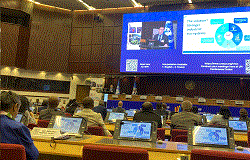
By Yordanos Tadesse – The 12th session of the Africa Regional Forum on Sustainable Development opened at the United Nations Conference Centre in Addis Ababa.
In his opening statement, Mr. Claver Gatete, United Nations Under-Secretary-General and Executive Secretary of ECA said: “As we speak, global growth is slowing, inequalities within and between countries are widening, fiscal pressures are mounting, climate shocks are intensifying, and conflicts, including geopolitical tensions in the Middle East, continue to weigh on global stability and resilience. Yet, we must not allow these challenges to constrain our ambition.”
On the contrary, they should compel us to reflect, innovate and redouble our efforts at finding lasting solutions to our long-standing development challenges.
This is what the moment demands.
The event opened on Tuesday brought together policymakers, academics, and private sector leaders to discuss pathways towards a sustainable, inclusive, and competitive industrial development trajectory for Africa.
During the opening session of the side event, ‘Industrial Futures Transforming Africa for Sustainable Development’, Nobuya Haraguchi, P.H.D Officer in Charge of the Division of Industrial Policy Research and Statistics at UNIDO, warned that the Current path is “unsustainable path” that will leave billions in poverty and hunger by 2050 unless global industrial systems are fundamentally transformed.
Mr. Haraguchi P.H.D mentioned that 3.15 billion people under the poverty line with nearly 700 million in extreme poverty. It is stated that 13.5 million additional deaths are projected due to a 2.3°C rise in global temperatures.
The impacts will remain concentrated in vulnerable economies. By 2050, if the current trajectory persists, the most severe social deprivations are expected to remain highly concentrated in specific regions, reinforcing global extreme poverty and inequalities.
It is also stated that 94% of extreme poverty will be concentrated in low-income economies, further widening the global inequality gap.
He stated that industrial development continues lagging behind. In 2025, most developing regions have a smaller share of global manufacturing than their share of the world’s population. This indicates that developing regions are under represented in the global industrial landscape relative to their population size
He stated that the sector has a powerful multiplier effect; every new industrial job creates two additional jobs in other sectors.