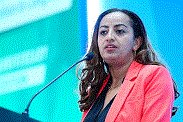
Domestic medical supplies production now covers 42 percent of Ethiopia’s need says, Ministry of Health of Ethiopia. According to Minister of Health Dr. Mekdes Daba, the contribution and increase domestic production of medical supplies from 8% to 42%, has helped Ethiopia reduce foreign currency pressure by saving more than 53 million US dollars annually.
She made the remark speaking at the opening of the 2nd Medical Products Manufacturing Exhibition and the 10th Ethio Health Expo, the Minister stated that focused efforts are underway to replace imported medical supplies with locally manufactured products.
She noted that more than 25 companies are actively engaged in pharmaceutical and medical supply manufacturing in Ethiopia. Dr. Mekdes also indicated that Ethiopia’s total health expenditure has reached 127.47 billion Birr, which is 6.3% of the country’s Gross Domestic Product (GDP).
The exhibition focuses on healthcare services, medical equipment, pharmaceutical value chains, and digital health systems. More than 90 international and local companies are participating in the event. Additionally, the exhibition aims to showcase the capacity of local pharmaceutical and medical equipment manufacturers, create market linkages, and announce strategic goals for the sector.
In a related development, Ethiopian Investment Commission’s report shows that Ethiopia’s domestic pharmaceutical sector is experiencing rapid growth, driven by a 15% annual market increase and high government priority for import substitution. Although 80–90% of medicines are currently imported, the local industry aims to grow market share through investments in industrial parks like Kilinto, with the overall pharmaceutical market expected to reach $2.6 billion by 2030.
Key Growth Factors and Trends
– Production Capability: As of January 2026, domestic manufacturers operate at roughly 29% of their capacity, revealing a major opportunity for expansion and import substitution.
– Market Growth: Demand for pharmaceuticals has been growing at an average of 15% annually over the past five years, projected to reach $1.8 billion in 2025 and $4 billion by 2030.
– Public Procurement Priority: The government prioritizes locally produced pharmaceuticals, and roughly 60–75% of total pharmaceutical spending in Ethiopia occurs within the public sector.
– Key Growth Drivers: Rising demand is fueled by a growing population, increasing middle class, expanding health infrastructure, and higher diagnosis rates.