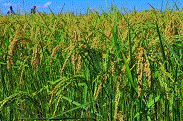
The Ministry of Agriculture of Ethiopia says the country has planned to cover 21.8 million hectares of land with different seeds this Meher farming season
The Meher season is Ethiopia’s main agricultural season, producing 85–95% of the country’s food crops, with planting in May-July and harvesting from September to February. It relies on the June-September kiremt rains, and is critical for staples like teff, maize, wheat, and sorghum, with 2024-2025 prospects generally favorable.
Teff, niger seed, faba bean, and chickpeas are among the most critical seeds which are used as major food items in Ethiopia, serving as staples for daily nutrition and culinary staples. Teff is the primary grain used to make injera (flatbread), while pulses like faba beans and chickpeas (often termed ‘shiro’ or ‘kik’) are essential for protein-rich sauces and stews.
The State Minister of Agriculture, Meles Mekonnen (PhD), announced that a plan has been set to cover 21.8 million hectares of land with seeds during this year’s Meher farming season. he made the announcement during his briefing regarding the 2018/19 (E.C.) Meher and Belg season crop development campaign. In his statement, State Minister Meles Mekonnen (PhD) noted that Meher, Belg, and Summer irrigation development activities are being carried out in an integrated manner to ensure Ethiopia’s food sovereignty, according to the state news agency ENA.
The State Minister Meles Mekonnen stated that movements are being made to increase crop production through land coverage and productivity under the theme: “Ensuring national food sovereignty by increasing production and productivity.”
State Minister Meles Mekonnen pointed out that since Ethiopia has a crop development ecosystem suitable for agricultural work, a plan has been prepared and put into action to increase production and productivity by identifying the resources available in the regions.
State Minister Meles Mekonnen mentioned that since the 2011/12 production year, the land tilled for Meher, Belg, wheat development, and other products, as well as the yield obtained per hectare, has increased significantly.
The State Minister Meles Mekonnen noted that the summer irrigation wheat development, which started on 3,500 hectares of land in 2011 (E.C.), has reached 4.2 million hectares this year. In this regard, he pointed out that the initial 100,000 quintals of production has risen to 175 million quintals this year.”
He mentioned that Meher wheat development has grown from the 1.75 million hectare coverage it had in 2011 (E.C.) to over 4.4 million hectares currently. “Following the annual increase shown in Meher crop development land and productivity per hectare, he announced that a goal has been set to cover 21.8 million hectares of land with seeds for the upcoming 2018/19 Meher season.”
He also stated that for Belg farming, it is planned to cover 4.2 million hectares of land with seeds, and 3.8 million hectares of land have been prepared so far. He added that the commitment of the leadership has played a decisive role in the success recorded in Ethiopia’s agricultural sector.
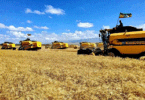
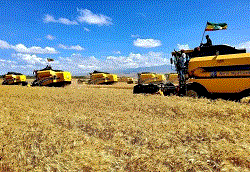
He explained that the expansion of cluster farming, the growth in the supply of agricultural mechanization machinery, and the improvement in the supply of fertilizers and improved seeds are notable reasons for the growth of the agricultural sector.
In Ethiopia there are three major farming seasons:
1 – Meher (Main Season): Rainy Period (Kiremt): June to September. Harvesting: September to February (covering major crops like maize, wheat, sorghum, teff, and barley). Produces the vast majority of Ethiopia’s food, with peak rain in July/August.2 – Belg (Short Season): Rainy Period: February to April/May. Harvesting: May to June. Important for early food security, primarily planting maize, sorghum, and long-cycle crops. It helps prepare the soil for the Meher season.
Bega (Dry Season): Duration: October to January. Primarily the harvesting period for the Meher season and a time for preparing fields for the next Belg season.