Ethiopia launched an ambitious economic reform program at the start of the 2024/25 budget year, backed by international partners such as the IMF and World Bank. Nearly two years on, the reforms have begun to reshape the country’s fiscal and monetary landscape, strengthening exports, revenues, and reserves. Yet unforeseen global shocks—most notably the ongoing Middle East conflict—pose new challenges to sustaining progress.
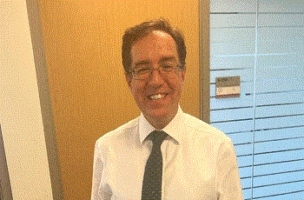
At the 2026 Spring Meetings, New Business Ethiopia’s contributor senior journalist Muluken Yewondwossen sat down with Alvaro Piris, IMF Assistant Director for Africa and Mission Chief for Ethiopia, to discuss the reform’s achievements, the impact of external pressures, and the road ahead.
Question: You will be visiting Ethiopia in the coming weeks for the fifth review of the macroeconomic reform program that began in mid-2024. What specific areas will your mission cover, and how would you assess the progress of the reform so far?
Alvaro Piris: We will be there in May and will discuss the evolution of the economy, including how the program is progressing in terms of meeting performance criteria and structural benchmarks. We will cover fiscal policy, monetary policy, exchange rate developments, structural reforms, and everything that is typically addressed in each review.
For this particular review, we will focus more on the impact of the Middle East conflict on the Ethiopian economy and consider what policy responses may be appropriate. We will also examine how this external shock affects the program’s design and whether any adjustments are needed. In terms of overall performance, it is useful to distinguish between the period before the conflict and after.
Through March, the economic picture was quite strong. Part of our review mission involves verifying data, and the information available through March indicated that the economy was performing well. Inflation had been declining, fiscal revenues were solid, exports were doing well, and international reserves were rising. So overall, the situation was very positive.
Then the Middle East war began, and this represents a major external shock for Ethiopia, given its dependence on the Gulf for fuel and fertilizer. That will be the key challenge in the months ahead, and we need to assess how it affects the economy across various dimensions—and possibly others we have not yet fully considered.
Question: Nearly two years have passed since the reform program started, with certain preconditions put in place to support it. What is your assessment? Would you say the authorities remain committed to implementation as originally agreed?
Alvaro Piris: The authorities have delivered on their commitments so far. The program has been implemented as designed, and in some areas performance has been strong. The economic benefits of the reforms are becoming visible in the Ethiopian economy. For example, the strong export performance is a clear consequence of the changes made to the exchange rate regime, as well as to fiscal and monetary policy. There are other examples as well.
On the fiscal side, difficult decisions regarding tax policy and tax administration have generated additional resources, which have been used to fund safety net programs and to ease social spending on health and education. So the benefits of tough decisions are already evident.
Question: Some experts have argued that the government is not fully committed on certain issues—for instance, the introduction of a fuel tax and the removal of the credit cap. What is your response to such concerns?
Alvaro Piris: Let me address each in turn. On fuel, the commitment is ultimately to eliminate subsidies and use fiscal resources in a more targeted manner that better serves the population. That commitment remains firm, and strong progress had been made toward meeting it until the Middle East war. Now that international oil prices have surged, the subsidy gap is widening again.
This will be one of the topics for discussion: how to maintain this commitment in a fiscally responsible way while also accounting for the social effects of policy changes such as raising fuel prices. That will be an important debate.
On the credit cap, this is more a matter of timing. We are in full agreement with the authorities that the cap should ultimately be removed and that Ethiopia should move toward an interest rate-based monetary policy framework that does not rely on quantitative limits like a credit growth cap.
There are pros and cons at any given moment. The question is whether to remove it now or keep it for another three or six months. That is the nature of the debate, but I have no doubt about the authorities’ commitment to eventual removal.
Question: In your recent report, the IMF indicated that it would provide only 50 percent of the reform assistance targeted for the current budget year. Why is that?
Alvaro Piris: Our lending is fundamentally for balance of payments support. That means we provide foreign exchange to smooth adjustment and facilitate external payments. Sometimes it makes sense to make some of those funds available for government budget support if a fiscal financing constraint is contributing to a balance of payments problem. That has been the framework of discussions so far.
We assess this on a review-by-review basis. When we return in May, we will look ahead and evaluate what the external and fiscal financing constraints are and how we can best address them. So we are not ruling out providing further budget support from our disbursements in future reviews.
The statement in the report referred specifically to the current fiscal year. That report will be reviewed by the Board in July, and at that time we will determine what makes sense regarding the use of disbursements to help finance the budget.
Question: At the joint IMF-World Bank Spring Meetings, the Governor of the National Bank of Ethiopia stated that they are discussing with partners how to overcome the impact of the Gulf conflict. Do you anticipate any changes to the reform program? Might the IMF grant some policy relaxation?
Alvaro Piris: I would not frame the debate that way. Rather, we have agreed with the authorities on a set of reform objectives. The program has clear goals. The question is always how best to achieve those objectives. When we come for reviews, we are not looking to change the objectives themselves. Ultimately, we still want a market-determined exchange rate, an interest rate-based monetary policy, and a sustainable fiscal policy built on reliable revenue sources and financing. Those remain in place.
The crisis will affect our debate in the following way: the world has changed, economic prospects are different, so what adjustments in the program, fiscal policy, or monetary policy are needed to ensure we can still achieve the program objectives?
It is not a question of giving up on ideas, but rather of how to achieve the shared objectives—objectives that are ultimately those of the authorities, which we support. That will be the framework of our discussions.
Question: Do you believe the reform can succeed given such unforeseen external circumstances?
Alvaro Piris: That is always the million-dollar question: how robust is any reform program to a major external shock? Personally, I am confident that we will find a way through. I want to take this opportunity to note that Ethiopia has performed very well since the program began. The economy has done better than either we or the authorities expected.
That has created some space and built buffers to manage a shock. Of course, this is a very large shock, and we will have to see how it plays out. But imagine if this had happened two years ago—the impact would have been dramatically worse because there were no buffers and no room to absorb further shocks.
So we have something to work with, and we have a very strong partnership with the authorities. We will work hard to manage the external shock and keep things moving in the right direction. So I am an optimist.
Question: I ask this because the policy on fuel subsidies may need revision. For example, the government’s budgeted fuel subsidy for the fiscal year was 100 billion birr, but it has already reached around 270 billion birr. Such challenges are real. That is why I raise these questions.
Alvaro Piris: I will not comment on those specific numbers because I do not recognize them. We will go on mission and discuss all of that, and determine where things actually stand. But certainly, this is exactly the kind of issue we expect to discuss: how to react to the shock, whether there is room to provide fuel subsidies, whether providing them is a good idea, what alternatives exist, and what the impacts of those alternatives would be.
All of that will be discussed. The long-term objective remains: there are better ways to spend public money. The government should be careful and redirect spending toward more productive and efficient uses, in particular supporting vulnerable households rather than using untargeted subsidies like fuel, from which even wealthy Ethiopians benefit. That is the basic idea. The challenge is how to get there.
Question: One of the reform strategies was to improve the net open position (NOP) of the Commercial Bank of Ethiopia (CBE). Given the current crisis and the need for foreign currency, do you think the CBE will be able to meet its NOP target set for February?
Alvaro Piris: Yes, we are confident. We will see where they stand during the mission, but there are reasons to be optimistic.
Question: During the Spring Meetings, you participated in a panel on capacity building. The Governor applauded the success achieved by the authorities—specifically the Central Bank and the Ministry of Finance. However, what about the private sector, particularly private banks? Many changes have been introduced during this reform period, but implementation at private banks appears limited. What is the IMF’s evaluation in this regard, and what support can partners provide to private banks and the broader private sector?
Alvaro Piris: Let me address the second part first. The IMF’s membership consists of countries, so we deal with the authorities. We do not provide technical assistance directly to the private sector. That said, we can help indirectly: if the authorities wish to provide training or organize a seminar for a private sector audience, we can assist them in preparing for that. So we can help in that manner, but we do not provide direct assistance to private entities.
On the more substantive part of your question: there is no question that the banking sector is facing fairly radical and deep-seated reforms in Ethiopia—changes to the foreign exchange market, interest rates, removal of financial repression, the treasury bill market, and many other simultaneous transformations.
Banks will face a challenge in adapting to new ways of doing business. That is part of business life. I would expect a potentially slow start, but competitive instincts and impulses will push banks to accelerate quickly and learn how to profit from the new setup and how to compete more effectively against one another.
So there are incentives in the private sector to adapt quickly to the new reality, and they will find ways to acquire the necessary knowledge. To summarize: we can support the authorities if they identify a capacity gap they wish to fill.
If they want to provide resources to help the private sector learn about, say, how a repo market works for domestic financing, we would be willing to assist the authorities in preparing and delivering that assistance. But we would not provide it directly.