A new factory, which can produce up to 50,000 square meters or 40 to 45 containers of traditional ceramic per day, is expected to commence production in three weeks.
The factory, which was built with an investment of 50 million US dollars in Tulefa town, 65 kilometers from Addis Ababa, was built by Baijia Ceramic Manufacturing, This ceramic and porcelain products factory, which is located on 30 hectares of land, is said to have the capacity to supply up to 70 percent of the current ceramic demand when it starts production, Sheger FM reported.
Once completed, Baijia’s factory will produce over 35,000 m² of floor and wall tiles per day, according to the initial investment plan as twitted by the Ministry of Mines of Ethiopia a few months ago.
Mansen Investments’ CEO Dawit Ergetu and Baijia Ceramic Manufacturing General Manager Zhang Hua signed an agreement to this effect. The report stated that Mansen Investments, the company that built Arada Mall and the Imagination Wellness, which was owned by the National Palace, has agreed to exclusively market the ceramics and porcelain products produced by Baijia Ceramic Manufacturing.
The agreement will allow Manson Investments to manufacture and exclusively distribute in Ethiopia specially designed ceramic and porcelain products suitable for the Ethiopian market through Baijia Ceramic Manufacturing.
Traditional ceramics are inorganic, non-metallic materials manufactured from naturally occurring raw materials such as clay, silica, and feldspar. These materials are processed through high-temperature firing to achieve desired properties like hardness, durability, and thermal resistance. Common traditional ceramic products include tiles, sanitary ware, tableware, and refractory materials used across residential and commercial applications.
Baijia Ceramic Manufacturing, on the other hand, is responsible for manufacturing the products in accordance with Manson’s technical standards, brand requirements and market specifications.
The agreement is expected to support the country’s industrial development plans by replacing imported products with domestic products, reducing foreign exchange outflows, and enabling the production of quality ceramic products in Ethiopia.
The global traditional ceramics market was valued at USD 72.59 billion in 2024 and is projected to grow from USD 74.86 billion in 2025 to USD 89.41 billion by 2031, exhibiting a CAGR of 3.1% during the forecast period. The market growth is driven by increasing construction activities globally, particularly in developing regions, coupled with rising demand for durable and cost-effective building materials.
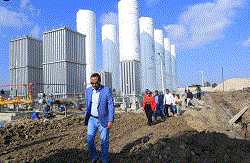
Eng. Habtamu Tegegne visited the Baijia Ceramic Manufacturing Project. Once completed, the factory will produce over 35,000 m² of floor and wall tiles per day, boosting local industrial development.#Invest In #Ethiopian pic.twitter.com/IFKSnryJrS
— Ministry Of Mines, Ethiopia (@MinistryofMine_) January 3, 2026