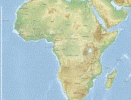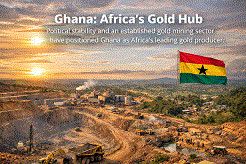
By Africa Risk Control- For many observers outside Africa, Ghana is not immediately associated with global industry. Yet the country plays a central role in the international gold market and has become Africa’s largest producer of the metal. In recent years its output rose sharply, reaching roughly six million ounces in 2025 after producing about four million ounces only two years earlier.
Gold is more than a major export for Ghana — it is a pillar of the national economy. The sector generates over forty percent of export earnings and contributes a significant share of government revenue. This makes mining activity closely tied to economic stability, public spending, and foreign investment. But understanding Ghana’s gold sector requires looking beyond the mines themselves.
A Mature Mining Country
Unlike frontier jurisdictions where exploration dominates headlines, Ghana has been producing gold for over a century. Many deposits are well mapped, and international mining companies operate long-established sites across the western and central regions.
Because production is relatively predictable, the industry functions less as a discovery story and more as an operational one. Mines operate continuously, exporting refined output through established channels to international markets.
This stability has made Ghana attractive to investors seeking lower geological uncertainty. However, it has also shifted attention toward the systems that keep mines operating day-to-day.
The Role of Supporting Businesses
A modern gold mine operates like a small industrial community. Heavy equipment must be serviced regularly, fuel supplies delivered on schedule, and materials transported safely between locations. Security, accommodation, catering, and procurement services all run alongside extraction.
As a result, the number of companies involved in mining far exceeds the number of mining operators. Many businesses participate indirectly by providing services or equipment rather than owning concessions.
For suppliers and contractors, Ghana’s mining sector therefore offers opportunities across logistics, engineering support, and industrial services. These activities often continue regardless of fluctuations in exploration activity because operating mines require constant maintenance.
Large and Small-Scale Production Together
Ghana’s mining landscape combines industrial operations with extensive small-scale mining. Smaller operators collectively contribute a substantial share of national output and employ large numbers of people in mining regions.
This dual structure shapes the broader market. Transport routes, labor pools, and local economies interact with both sectors simultaneously. It also increases attention on sourcing standards as buyers seek clarity on how gold moves from extraction to export.
Why Investors Watch Ghana
Mining attracts a large portion of foreign investment entering the country, and spending linked to the sector flows widely through the domestic economy. Even companies outside the resource industry — including engineering and logistics firms — often find business opportunities connected to gold production.
Rather than a short-term boom, Ghana represents a steady industrial environment built around ongoing extraction and supporting services. This continuity is part of its appeal for businesses seeking long-term presence rather than speculative entry.
Looking Beyond Production
While production figures explain the sector’s scale, the structure of commercial relationships around mining determines how operations function in practice. Service providers, procurement arrangements, and compliance requirements all influence day-to-day activity.
Africa Risk Control has published a detailed operational analysis explaining how Ghana’s mining ecosystem works and what companies should consider before entering partnerships.
Read the full analysis on the Africa Risk Control platform
EDITOR’S NOTE– Africa Risk Control (ARC) is a due diligence and risk advisory service provider operating in dozens of African countries. Corporate Due Diligence, Risk Advisory, Country Risk Insights, Background Checks, Identity Verification (for banks, governments, and institutions), Verification for Citizenship by Investment / Donations Programs, Verification for Permanent Residency by Investment / Donation Programs, Source Wealth Verification, Competitor Intelligence, and Market Entry Research are some of the major services ARC has been providing.