By Andualem Sisay Gessesse – Due its huge natural resources including critical minerals and the largest market union in the world, Africa is getting more attention by global investors. The latest implementation of the African Continental Free Trade Area (AfCFTA) by most of the countries, is now opening doors for small and medium Enterprises on the continent to link each other and expand their market and business partnerships, among others.
The AfCFTA was established through an agreement signed in 2018 and officially commenced trading in January 2021. It brings together 54 African countries, making it the largest free trade area in the world by number of participating states. AfCFTA aims to create a single continental market for goods and services, facilitate the free movement of business persons and investments, and strengthen Africa’s position in global trade by promoting intra-African commerce, industrialization, and regional value chains.
SMEs across Africa often approach the AfCFTA with optimism. Lower tariffs, access to larger markets, and the promise of regional integration are widely seen as gateways to growth. Yet, in practice, many SMEs struggle to benefit from AfCFTA—not because their products or services are weak, but because they remain largely invisible beyond their home markets.
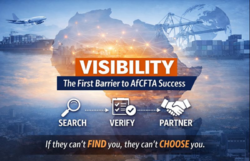
AfCFTA does not reduce competition. It intensifies it. By opening borders and expanding choice, it places African businesses into a much larger competitive arena. In this environment, visibility becomes the first and most decisive barrier companies must overcome—well before price, quality, or logistics are ever considered.
AfCFTA as a Discovery-Driven Market
AfCFTA is transforming African trade into a discovery-driven economy. Buyers, distributors, investors, and potential partners no longer rely solely on personal networks or local recommendations. Instead, they actively search across borders for suppliers, partners, and opportunities that meet their needs.
When they search, the results matter
For many African SMEs, the outcome is uncomfortable: very little appears. A company that does not show up in credible media, business discussions, or industry narratives effectively does not exist outside its domestic market. This invisibility quietly removes it from consideration long before any negotiation begins.
Imagine a venture capital firm based in South Africa exploring an investment in a medium-sized footwear manufacturing company in Ethiopia. Before requesting financials or arranging meetings, the firm conducts a basic due-diligence scan. The first step is not a factory visit—it is a media and background search. If the Ethiopian company has appeared in business media, trade discussions, or industry commentary, it signals legitimacy and operational seriousness. If it exists only on its own website and social media pages, uncertainty increases, regardless of product quality.
Visibility as Market Infrastructure, Not Promotion
Visibility is often misunderstood as cosmetic or optional—something to consider once sales improve or expansion is underway. Under AfCFTA, this thinking is outdated. Visibility functions as market infrastructure.
Distributors and partners operating across borders must quickly assess whether a company is legitimate, active beyond its home country, publicly referenced, and capable of operating within regional business norms. When there are no public signals to answer these questions, uncertainty grows. In competitive markets, uncertainty is rarely tolerated.
Deals are not lost because answers are negative; they are lost because answers are unavailable.
Many SMEs assume that visibility is cumulative—that appearing on multiple business directories, maintaining a company website, or having an active social media presence creates credibility. In practice, these forms of visibility carry limited weight in reputational assessment.
A single press release, interview, or feature published by a credible, independent media outlet often has far greater impact than ten directory listings or a well-designed website. This is because media coverage represents third-party validation. It signals that the business has been assessed, referenced, and deemed relevant by an external actor rather than simply promoting itself.
Why Distributors Avoid Invisible Companies
Distributors play the role of risk managers. When they represent a supplier, they commit time, capital, logistics, and their own reputation. As a result, they naturally prefer businesses that appear credible and verifiable.
When evaluating SMEs, distributors look for signs that a company is active, visible, and consistent in its messaging. Independent media references and participation in business conversations provide reassurance that the company is serious and accountable.
An invisible company, by contrast, demands more verification. It raises more questions and appears riskier by default. In AfCFTA markets—where distributors can choose among suppliers from multiple countries—most simply move on to businesses that feel easier to trust.
Visibility Comes Before Reputation
Some SMEs believe they can postpone visibility and focus on reputation later. This misunderstands how reputation is formed.
Reputation cannot develop in the absence of visibility. Visibility is the doorway through which reputation emerges over time. Strategic visibility—through credible media, industry platforms, and thoughtful commentary—creates the conditions for reputation to grow organically. Without it, even highly capable companies remain unknown.
AfCFTA Rewards Recognition, Not Just Capability
– AfCFTA does not reward effort alone. It rewards recognition.
Companies that are visible are discovered more quickly, contacted more frequently, shortlisted more often, and perceived as serious participants in regional markets. Those that remain invisible, regardless of their potential, tend to stay confined to local markets—not because they lack value, but because they lack presence.
Visibility as a Strategic Choice
Visibility does not mean constant promotion or excessive publicity. It means being deliberate and consistent about where and how a business appears.
For SMEs seeking AfCFTA opportunities, this involves engaging with business and sector media, participating in regional African platforms, contributing to cross-border trade discussions, and shaping industry-relevant narratives. This type of visibility does not happen accidentally. It must be built intentionally over time.
Waiting for the market to “discover” a business is rarely a successful strategy in a crowded, competitive environment.
AfCFTA Separates the Visible From the Forgotten
– AfCFTA creates opportunity—but only for businesses that can be seen.
For African SMEs, visibility is no longer optional. It is the first step toward regional relevance, meaningful partnerships, and sustainable growth. In an integrated African market, the difference between expansion and stagnation often begins with one simple question: can others find you?
Many African businesses exploring AfCFTA opportunities are beginning to reassess how visibility, reputation, and media presence affect cross-border partnerships and due diligence outcomes. Strategic communication and long-term reputation management are increasingly becoming part of market readiness for regional expansion.