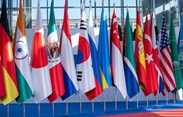
By Abdullah Vawda – The G20 summit in South Africa, a gathering of the world’s major economies, ended with a joint declaration committing to “multilateral co-operation” including climate change mitigation and economic inequality, and was adopted despite objections from the US which boycotted the meeting in Johannesburg as reported by the BBC.
World leaders have heaped praise on South Africa for hosting a successful G20 Summit. President Cyril Ramaphosa says putting Africa’s growth and development at the centre of the G20 agenda will bring the continent and the bloc closer together.
South Africa’s hosting of the G20 Leaders’ Summit has inspired local technology firms, which say the event will spotlight the country’s innovation capabilities, attract foreign investment, and open new opportunities for digital trade and partnerships.
Importantly, the expiration of US led ‘African Growth and Opportunity Act (Agoa)’ should not be seen as a setback for African nations but rather as an opportunity to strengthen local industries, upskill workforces and expand regional trade, experts have said.
“African markets can leverage their skills to develop their markets and also strengthen intra-African trade through the African Continental Free Trade Area (AfCFTA)”, said Rose Ngugi, a fellow in the African Economic Research Consortium (AERC).
The unprecedented Trump-imposed tariffs have not had as significant an effect as expected in the near term, but there is a need to absorb their impact in the coming year, said the vice president for research at the Italian Institute for International Political Studies, Antonio Villafranca.
“International trade in 2025 is doing incredibly well. International trade will grow by 2.4%, while the forecast made in Africa when Trump announced the tariffs itself was -0.4. In just a few months, we moved from -0.4 to 2.4% which is quite good, but this is only an apparent effect of all these cloud studies. There are many expeditious ways going on.”
The inclusion of Sudan is significant, according to Sudanese commentator and journalist Saeed Abdalla. “I think for the first time, [at] the G20 now they bring the Sudan conflict [to the forefront] after more than two years,” he told local broadcaster Newzroom Afrika.
Modern Diplomacy in an article “Gibran’s G20 Play to Unlock Africa-Indonesia Powerhouse” explains how the G20 has always been a barometer of global power. Born out of the 2008 financial crisis, it promised to provide a platform for emerging economies to negotiate. But for years, that promise remained hollow. Decisions still flowed from Washington, Brussels, and Beijing. Southern countries watched, participated, but rarely led.
Johannesburg changed that calculus. South Africa, the summit’s host, sent a clear message: Africa’s voice mattered. Indonesia’s prominent role further strengthened it. The Indonesia-Africa trade corridor is expected to grow rapidly.
German Chancellor Fredriech Merz said it had not been a “good decision” for the US to abstain. He told Reuters news agency that what he had noted at the G20 was that “the world is currently undergoing a realignment and that new connections are being formed”.
—
EDITOR’S NOTE: Abdullah Vawda is a governance and strategic advisory specialist with extensive experience across Southern Africa. Based in South Africa, he combines expertise in communications, media management, and institutional development to support civil society, policymakers, and professional networks in strengthening transparency and accountability across the region. At Africa Risk Control, he leads the Southern Africa Desk, overseeing due diligence, intelligence gathering, and corporate investigations.