Within one week period, the Customs Commission of Ethiopia seized over half a billion Birr contraband goods, including narcotics destined to neighboring countries and smuggled into the country through border towns.
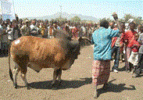
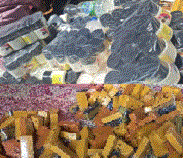
The seized contraband goods included new and used clothing, electronics, coffee, cereals, vehicle parts, cosmetics, khat, narcotics, medicines, minerals, livestock, and foreign currencies. “During the surveillance conducted by the Customs Commission from March 18 to March 24, 2026, some 486.3 million Birr of imported contraband goods and 20 million Birr of exported contraband goods with a total estimated value of 506.3 million birr were seized at various branch offices,” the commission said.
Within the specified time frame, Addis Ababa Airport, Jigjiga and Moyale Customs Branch Offices took the lead in controlling import and export contraband, seizing contraband worth 161 million, 110 million and 66 million Birr respectively.
The Commission stated that the contraband was seized through joint efforts of Customs Commission staff, Federal Police, Regional Police members and the community through searches, raids and raids, and 17 suspects and 10 vehicles found transporting the contraband were also arrested.
Official reports show that during the Ethiopian calendar year ended July 7, 2025, the Commission has collected a total of over 415 billion Birr.
As one of the major wings of the Ministry of Revenue of Ethiopia, since 2019 the Ethiopian Customs Commission has been organized in 16 regional offices, 10 industrial parks, 85 control stations, 11 recording and control stations, and 2 coordination offices abroad.
In a related development, the Ethiopian Federal Police, in coordination with the Ethiopian National Intelligence and Security Service and the Addis Ababa Airport Branch Office of the Customs Commission, announced that they seized more than 80 kilograms of cocaine and 590 kilograms of dangerous drugs at Addis Ababa Bole International Airport during a strict surveillance and inspection conducted from July 2025 to March 2026.
International traffickers tried to smuggle drugs in fish, chocolate, candy, biscuits, powder and various types of food, in liquid and soap form, as well as in the form of feminine hygiene products, toys and hair ornaments, by making bags, packing them in cardboard, swallowing them and hiding them in their hair, but they could not escape the skilled experts who worked with the help of modern technologies and sniffer dogs (K9).
The experts were able to arrest 33 drug traffickers of various nationalities, including suspects of Nigerian and Brazilian nationality, during a thorough search of the smugglers’ bodies, cargo and luggage.