Foreign-exchange (Forex) pressure remains one of Ethiopia’s most decisive risk drivers heading into 2026. While Forex shortages have shaped the business environment for years, Africa Risk Control’s (ARC) field intelligence and sector assessments indicate that Forex stress will increasingly influence strategic planning, operational continuity, and partnership viability in the coming year.
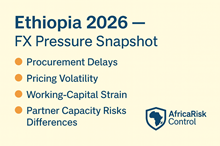
At the macro level, Forex constraints have been driven by structural imbalances between demand for foreign currency and available supply through official channels. However, what matters most to investors is not the macro narrative — but the practical implications for day-to-day operations. ARC’s reporting shows that Forex strain creates cascading delays that impact procurement, inventory management, production timelines, and pricing predictability. These operational disruptions remain one of the most underestimated factors in investor risk assessments.

For companies reliant on imported inputs, Forex shortages can extend procurement cycles significantly, introduce cost volatility, and disrupt supply-chain reliability. Even small delays in Forex allocation can affect contractual timelines, shipment schedules, and inventory levels. Manufacturing, logistics, healthcare, agribusiness, and construction firms are especially exposed to these dynamics because their operations depend on steady access to imported equipment, spare parts, and inputs.
Pricing stability is another area where Forex stress drives risk. Local price adjustments often lag behind fluctuations in parallel market rates, creating mismatches that affect margins and working capital. ARC’s assessments show that companies relying on outdated Forex assumptions or uniform pricing models face increased exposure as price corrections accelerate across sectors.
FX pressure also influences partner evaluation. Companies that appear financially stable may, in reality, face liquidity strain due to Forex access issues. This affects their ability to fulfill delivery obligations, sustain operations, or meet payment schedules. As a result, Forex-linked due diligence is becoming an essential part of partner verification and supplier assessment.
Forex constraints also intersect with political and regulatory risks. The pace of liberalization, import prioritization, and allocation frameworks may shift in 2026, introducing additional uncertainty. Investors need to understand how potential policy changes may impact sectors differently — and how regional dynamics influence actual on-the-ground FX access.
ARC’s Ethiopia Country Risk & Due Diligence Report 2026 Q1 Premium Edition provides forward-looking Forex diagnostics, sector-specific exposure mapping, and scenario-based outlooks to help organizations prepare for these uncertainties. By combining field reporting with sector-by-sector analysis, ARC offers practical insight into how Forex stress will influence operational decisions, pricing strategy, and risk mitigation.
Forex will remain a central factor shaping Ethiopia’s 2026 risk environment. Organizations that build strategies around realistic Forex assumptions — informed by updated intelligence — will be better positioned to protect capital, maintain continuity, and capitalize on emerging opportunities.
Unlike traditional consultancies, ARC is powered by a network of investigative and business journalists in 32+ African countries. With boots on the ground, Africa Risk Control uncovers realities beyond desk research — from hidden ownership structures to political exposure, regulatory shifts, and reputational risks.
Africa Risk Control’s Ethiopia 2026 Premium Report provides deeper political scenarios, region-level mapping, FX diagnostics, regulatory exposure, and due-diligence guidance.
Get the full premium Africa Risk Control’s report here with one hour intelligence briefing call with our country desk chief: https://lnkd.in/dzcKmfTA
Request free Summary: info@africariskcontrol.com
Get Ethiopia Micro Risk Brief Q1/2026
You can also book Supplementary Intelligence Briefing call here
Ethiopia Country Risk Profile 2026 is also Now Available.
To Learn More About Africa Risk Control’s Services, Book A 20-Minute Free Consultation Here.