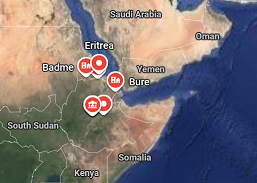


As global attention remains fixed on conflicts in Eastern Europe and the Middle East, a quieter but potentially more consequential geopolitical realignment is unfolding along the Red Sea and East Africa corridor.
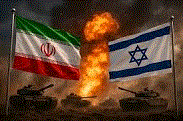
Sudan’s civil war, Ethiopia–Eritrea tensions, and intensifying foreign involvement by the United States, Saudi Arabia, the United Arab Emirates, Egypt, Iran, Russia, and China are no longer separate developments. According to a new Strategic Intelligence Memo by Africa Risk Control (ARC), these dynamics are increasingly merging into a single contest system centered on global trade routes, port access, and strategic alliances.
Recent developments illustrate the shift. Sudan’s conflict has drawn renewed U.S. attention after Saudi Arabia urged Washington to intervene, framing the war as a Red Sea security threat rather than a distant African crisis. Eritrea’s President Isaias Afwerki’s high-profile visit to Port Sudan sent a clear political signal of alignment at a sensitive moment. Meanwhile, Ethiopia faces growing internal pressure and external diplomatic signaling as tensions over Red Sea access and regional influence rise.
What makes this convergence particularly significant is geography. The Red Sea carries a substantial share of global container traffic, and recent disruptions have already forced shipping reroutes, higher insurance costs, and supply-chain delays worldwide. As a result, conflicts in Sudan or a miscalculation between Ethiopia and Eritrea now carry consequences far beyond the Horn of Africa.
ARC’s analysis warns that the region shows early characteristics of Yemen- or Syria-style proxy fragmentation, where multiple external powers pursue competing interests through local partners, deniable support, and long-term strategic positioning rather than direct confrontation. Once such systems entrench, they become difficult—and costly—to reverse.
For investors, development partners, and policymakers, the implication is clear: assumptions based on past regional stability no longer hold. Decisions made over the next 6–18 months could reshape risk exposure across logistics, energy, agriculture, and infrastructure projects tied to the Red Sea corridor.
Read the full 32-page ARC Strategic Intelligence Memo: Foreign Powers’ Matches in the Red Sea & East Africa: A Yemen/Syria-Style Proxy Fragmentation Risk in the Making
ARC is launched in mid 2025 by a group of award winning investigative and business journalists based in different African countries, it aims to safeguard investments and reveal the truth behind opportunities in Africa by providing due diligence and risk advisory services and producing risk intelligence reports.