
By BEHAK PR Solutions – For many African small and medium enterprises (SMEs), public relations has long been viewed as a secondary concern—something to be addressed after growth, after profitability, or after international expansion. In practice, this perception is increasingly detached from how business decisions are made in today’s regional and global markets.
As African economies integrate and competition intensifies, visibility and reputation are no longer optional. They have become prerequisites for participation. The launch of the African Continental Free Trade Area (AfCFTA) has accelerated this shift. Signed in 2018 and operational since January 2021, AfCFTA brings together 54 African countries into the world’s largest free trade area by number of participating states. Its ambition is to create a single continental market for goods and services, facilitate the movement of capital and businesspersons, and strengthen Africa’s position in global trade through deeper intra-African commerce.
While AfCFTA expands opportunity, it also changes how African businesses are evaluated.
From Familiarity to Scrutiny
Historically, many African business relationships were built on proximity and familiarity. Partners knew each other through personal networks, shared markets, or long-standing relationships. Under AfCFTA, that context is shifting. Businesses are now assessed across borders by partners who may have no prior exposure to local reputations or informal endorsements. In this environment, scrutiny replaces familiarity.
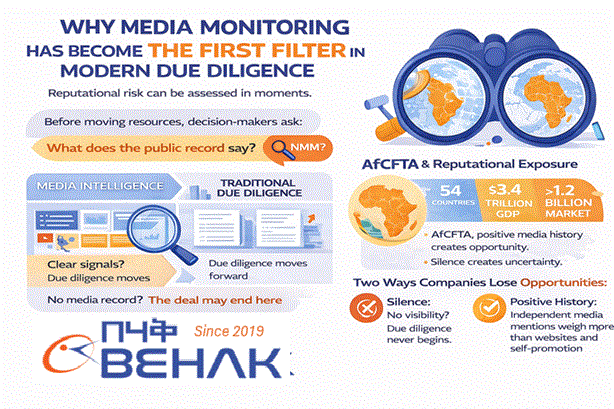
Distributors, investors, development partners, and procurement teams increasingly rely on publicly available information to assess credibility. Before engaging, they ask basic questions: Is this company legitimate? Is it active beyond its home market? Has it been referenced or validated by independent sources? Does it appear prepared for external accountability?
These questions are rarely asked directly. They are answered quietly through online searches, media scans, and reputational checks.
Why Reputation Now Precedes Engagement
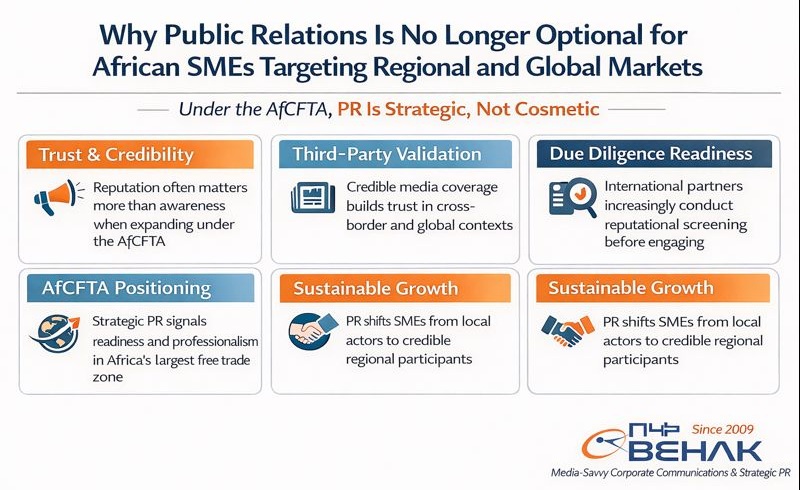
For SMEs seeking to expand regionally or globally, the first barrier is no longer market access or logistics. It is reputation.
Cross-border engagement exposes all parties to shared commercial and reputational risk. As a result, partners prefer businesses that appear easier to evaluate and defend internally. Companies with visible, credible public footprints are perceived as lower-risk counterparts, even before formal due diligence begins.
This does not mean that businesses without public visibility are incapable. It means they are harder to assess. In competitive environments, difficulty translates into delay—and delay often translates into exclusion.
The Limits of Self-Published Visibility
Many African SMEs assume that visibility is cumulative. They invest in websites, register on business directories, and maintain social media accounts, believing that these steps establish credibility.
In reality, these forms of visibility are expected but insufficient.
A company website is a baseline requirement. Social media activity demonstrates engagement but offers limited independent validation. Directory listings are easy to obtain and rarely scrutinized.
What carries greater weight is third-party recognition.
A single interview, feature, or press release published by a credible, independent media outlet often has more impact than multiple self-published assets. This is because media coverage represents external validation. It signals that the business has been assessed, referenced, and deemed relevant by an actor outside its control.
For partners unfamiliar with a local market, this distinction is decisive.
A Cross-Border Business Scenario
Consider a private equity firm based in Southern Africa evaluating manufacturing SMEs in East Africa for potential partnership. Before requesting financial statements or commissioning site visits, analysts conduct an initial reputational review. They search for independent media coverage, business interviews, and public references to the companies and their leadership.
One firm appears in regional business media, has been quoted on industry trends, and has participated in public discussions relevant to its sector. Another firm, with similar financial performance, has no public footprint beyond its own website.
The first firm is easier to evaluate. Its visibility suggests readiness for scrutiny and engagement. The second appears riskier—not because it lacks capability, but because it lacks external validation. In many cases, the first firm advances to deeper engagement while the second does not.
This dynamic is increasingly common across AfCFTA markets.
Public Relations as Market Infrastructure
In this context, public relations functions as market infrastructure rather than promotion. It enables businesses to signal readiness for regional participation by establishing coherence, credibility, and continuity in how they are perceived externally.
This is particularly important for SMEs that cannot afford physical presence across multiple markets. Strategic PR allows relevance without permanent offices. It enables businesses to participate in broader economic and sectoral conversations that extend beyond national borders.
Importantly, this is not about constant publicity. It is about deliberate, consistent presence in the right forums.
Reactive Communication and Its Limitations
A common mistake among SMEs is engaging in communication only when prompted by opportunity or crisis. This reactive approach rarely works in competitive, high-scrutiny environments.
Reputation cannot be built on demand. Trust develops over time, through repeated exposure and independent reference. Businesses that wait until they need visibility often discover that it cannot be accelerated to match commercial timelines.
Strategic communication is preventative rather than reactive. It ensures that when scrutiny increases—whether through partnership discussions, investment reviews, or procurement processes—the public record supports the business rather than raising questions.
Aligning With Global Due Diligence Expectations
As African SMEs engage international partners, they increasingly encounter global due diligence standards that extend beyond financial performance. Reputational screening has become a standard first step.
Companies with no media footprint appear unprepared for this reality. Those with consistent, credible public presence appear more professional and easier to engage.
Public relations, in this sense, does not replace due diligence. It complements it by ensuring that the external narrative aligns with the internal reality of the business.
AfCFTA Rewards Preparedness
AfCFTA represents a long-term structural shift in how African businesses interact with each other and with global markets. The beneficiaries will not be determined by ambition alone, but by preparedness.
For African SMEs targeting regional and global markets, public relations is no longer discretionary. It is part of the cost of serious participation.
In an environment where visibility shapes trust and trust shapes opportunity, reputation has become a business asset—one that must be built deliberately and sustained over time.
EDITOR’S NOTE:
BEHAK is an Africa-focused strategic communications and public relations firm headquartered in Addis Ababa, Ethiopia. Established in 2019 by veteran journalists, the firm delivers public relations services grounded in credibility, media intelligence, and a deep understanding of Africa’s political, institutional, and media landscapes.
BEHAK’s work spans five core service areas: Strategic Communication & Advisory, Media Relations & Publicity, Crisis Management & Response, Digital PR & Content Marketing, and Event Management & Measurement, supporting organizations seeking to build trust, manage reputation, and engage effectively with regional and global audiences.