
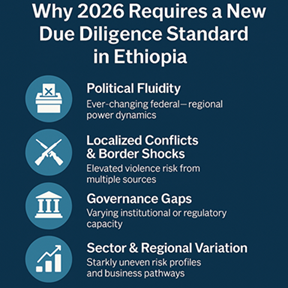
By Africa Risk Control (ARC) – As Ethiopia enters 2026, the pace and nature of risk evolution demand a shift in how organizations approach due diligence. Standard document checks and historical assumptions no longer provide the visibility needed for confident decision-making. Africa Risk Control’s (ARC) field intelligence across Ethiopia and neighboring countries shows that a more adaptive, multi-layered due diligence framework is essential for the year ahead.
One major driver is political recalibration. The relationships between federal and regional authorities are shifting, and investors can no longer rely on the stability of past alignments. These changes affect licensing behavior, administrative processes, and local partner influence. Document-only checks rarely capture how political realignments shape real-world decision-making environments.
A second factor is the country’s increasingly localized conflict patterns. While large-scale conflicts are less dominant, localized clashes, community tensions, mobility restrictions, and border-area spillovers significantly impact operations. These realities are often absent from central reporting but directly affect project access, supply-chain reliability, and partner capacity.
FX shortages and macroeconomic pressure add another layer of complexity. Companies facing liquidity strain may resort to informal arrangements or undisclosed partnerships to continue operating. Such developments pose governance, compliance, and reputational risks that will not surface in registry documents, tax filings, or administrative paperwork.
Sector exposure is also becoming more uneven. Logistics, agribusiness, manufacturing, construction, and energy each face distinct operational pressures tied to region-level variation and fast-changing security conditions. Due diligence must now integrate sector-specific risk considerations rather than applying a one-size-fits-all checklist.
Finally, governance inconsistencies are increasing. ARC’s assessments show that more companies now operate with gaps between their documented structures and their actual practices. Hidden ownership, unreported liabilities, weak internal controls, and informal supply-chain dependencies require verification far beyond traditional due diligence.
For these reasons, 2026 requires a new due diligence standard—one grounded in field intelligence, multi-source verification, and continuous assessment rather than static documentation.
ARC’s Ethiopia Country Risk & Due Diligence Report — 2026 Q1 Premium Edition reflects this shift. Built through investigative fieldwork, local verification, stakeholder interviews, and region-by-region analysis, the report offers a forward-looking framework for navigating Ethiopia’s emerging risk environment.
Organizations preparing to enter or expand in Ethiopia in 2026 will need more than paperwork checks. They will need due diligence aligned with the realities of a fluid, regionally diverse, and rapidly evolving landscape.
Access the 107-page Ethiopia 2026 Premium Report
Book a 20-minute consultation about ARC’s services
EDITOR’S NOTE– Africa Risk Control (ARC) is a due diligence and risk advisory service provider operating in dozens of African countries. Corporate Due Diligence, Risk Advisory, Country Risk Insights, Background Checks, Identity Verification (for banks, governments, and institutions), Verification for Citizenship by Investment / Donations Programs, Verification for Permanent Residency by Investment / Donation Programs, Source Wealth Verification, Competitor Intelligence, and Market Entry Research are some of the major services ARC has been providing.