
By BEHAK – Humanitarian organizations working with refugees often try to stay out of public debate. The instinct is understandable.
Displacement issues are politically sensitive, emotionally charged, and frequently misunderstood. Many NGOs therefore focus on operations rather than communication, believing discretion protects neutrality.
In practice, the opposite can happen.
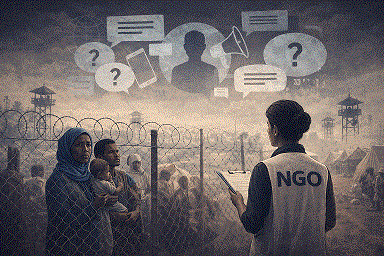
In refugee settings, limited public information does not create neutrality — it creates uncertainty. And uncertainty, in highly scrutinized environments, quickly turns into risk.
Across Africa, NGOs deliver healthcare, education, protection services, and livelihoods support to displaced communities where state capacity is stretched.
Their work is essential. But their ability to continue depends not only on technical performance. It depends on whether governments, donors, communities, and the public trust them enough to operate.
Today, trust is shaped as much by public visibility as by field operations.
Displacement Environments Multiply Scrutiny
Refugee operations involve many actors at once: host governments, security agencies, local communities, international organizations, and donors. Each group views NGOs through a different lens — legal compliance, security implications, political sensitivity, or financial accountability.
Because of this overlap, reputation becomes operational infrastructure.
If stakeholders cannot easily understand what an organization does, who runs it, and how it works, they begin filling gaps with assumptions. Even well-managed programs can face delays or resistance simply because they are not clearly understood.
This is why communication strategy has become part of humanitarian risk management. Organizations increasingly work with professional communications teams such as BEHAK PR Solutions to ensure accurate public information exists before misunderstandings emerge.
The Kenya Example: Where Perception Shapes Access
Kenya hosts large refugee populations from neighboring conflict-affected countries. NGOs provide shelter, education, healthcare, and psychosocial support in environments that are often debated domestically in terms of migration policy and national security.
In such a context, credibility determines operational space.
Organizations with consistent public documentation — media references, transparent messaging, and clear mandates — generally coordinate more smoothly with authorities and partners. Those operating quietly often face more questions, not fewer.
Public communication does not mean advocacy. It means clarity. Neutral, factual visibility helps stakeholders understand that humanitarian work supports stability rather than undermining it.
Professional media engagement, when structured carefully through firms experienced in policy environments like BEHAK PR Solutions, allows organizations to present accurate information without politicizing their mission.
Why Silence Can Create Suspicion
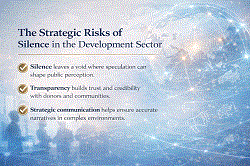
Some NGOs avoid communication to prevent controversy. Yet in refugee contexts, silence can unintentionally invite speculation. Local rumors, social media narratives, or political commentary can fill informational gaps rapidly.
Without credible references, organizations are forced into reactive communication — responding to narratives they did not create.
Strategic visibility prevents this cycle. It establishes a factual baseline so misinformation has less room to grow. The goal is not publicity, but predictability: stakeholders know who the organization is and what it does before questions arise.
Independent Media as Third-Party Validation
In humanitarian environments, independent media coverage plays a stabilizing role. Responsible reporting contextualizes operations and explains constraints that internal reports cannot communicate externally.
For donors conducting due diligence, a neutral media reference often carries more weight than internal documentation. It demonstrates that the organization’s activities have been observed and interpreted by an independent editorial process.
This is why many NGOs increasingly integrate communications planning into program design, often coordinating outreach through experienced regional communications partners like BEHAK PR Solutions, who understand both development work and public-policy sensitivities.
Funding Decisions Now Include Media Reviews
Refugee programs require long-term financing, and donors face reputational exposure when supporting them. As a result, funding assessments increasingly include online and media background reviews.
Donors ask simple questions:
-
Is the organization publicly documented?
-
Are its activities consistently described?
-
Has it been involved in controversy?
-
Do public narratives match its mandate?
Organizations with clear public records are easier to support internally. Those without visibility require more explanation, even when operationally effective.
Communication therefore becomes preventative risk management rather than marketing.
Explaining Challenges Builds Credibility
Humanitarian work rarely runs smoothly. Funding gaps, policy changes, and security issues affect operations regularly. Communicating these realities responsibly strengthens credibility rather than weakening it.
Stakeholders expect complexity. What they need is transparency.
Through structured engagement with credible platforms and professional communications guidance, NGOs can explain constraints while reinforcing neutrality and professionalism.
Avoiding communication entirely can create the impression that challenges are hidden rather than managed.
Trust Enables Continuity
For organizations supporting displaced populations, reputation directly affects access, coordination, and staff safety. When trust weakens, operations slow. When trust strengthens, cooperation improves.
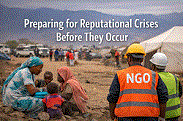
Public relations in refugee contexts is therefore less about visibility and more about continuity. It ensures stakeholders understand humanitarian roles before crises occur.
In refugee-hosting countries such as Kenya, communication is not about attention — it is about maintaining the operational space required to continue essential services.
EDITOR’S NOTE: The contributor of the article, BEHAK PR Solutions is a strategic communications and public affairs advisory firm based in Addis Ababa, working with organizations operating across policy-sensitive environments in Africa. The firm supports institutions in presenting accurate, factual information about their activities to stakeholders including media, regulators, and partners.
Its work focuses on credibility-centered communication — helping organizations explain complex operations clearly, reduce misunderstandings, and strengthen institutional trust in environments where public perception can affect operational continuity.
Learn more about BEHAK PR Solutions.