
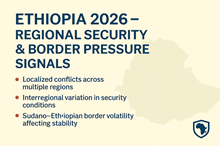
Ethiopia’s risk landscape in 2026 continues to be shaped by a combination of internal political dynamics, localized conflict patterns, and regional instability—including spillover pressures from neighboring Sudan. Africa Risk Control’s (ARC) field intelligence shows that the interplay between internal security variation and external shocks is now one of the most critical factors for investors assessing project feasibility, mobility, and partnership decisions.
One of the most overlooked realities is the uneven nature of security improvement and decline across regions. Some parts of the country have seen relative stabilization, while others continue to experience localized clashes, political–community tensions, or corridor disruptions. These variations directly impact logistics planning, workforce mobility, partner operations, and field deployments. National-level reporting cannot capture this complexity; only region-level intelligence reveals where operational exposure is increasing or decreasing.
Border dynamics are becoming equally significant. The war in Sudan continues to shape security pressures along Ethiopia’s northwestern frontier, influencing displacement patterns, informal trade flows, and the stability of adjacent districts. These pressures affect humanitarian access, transport routes, and commercial movement across border-linked corridors. ARC’s assessments suggest that these dynamics will continue into 2026, requiring investors to incorporate cross-border considerations into their due-diligence frameworks.

At the same time, political recalibration between federal and regional authorities continues to influence administrative consistency. This affects licensing, compliance, sector approvals, and local partner reliability. Investors relying on outdated assumptions about political influence or institutional behavior may misjudge timelines or exposure.
Sector-level risks also differ.
• Agribusiness faces exposure to corridor disruptions and community tensions near production zones.
• Energy and infrastructure projects must navigate land access dynamics and localized political sensitivities.
• Mining is affected by regional disputes, informal activity, and security unpredictability.
• Logistics and transport depend heavily on corridor-level stability, which varies month to month.
These differences underscore why Ethiopia cannot be assessed using broad, national-level risk categories. ARC’s Ethiopia Country Risk & Due Diligence Report — 2026 Q1 Premium Edition provides a forward-looking evaluation of how internal conflict trends, political fluidity, administrative variations, and border-related pressures intersect with sector-specific operations. The report helps organizations identify where exposure is rising, where opportunities remain stable, and where stronger mitigation strategies are needed. For investors preparing their 2026 strategies, understanding the full picture of regional security shifts and border dynamics is essential—not optional. Decisions grounded in outdated or incomplete intelligence carry growing operational, financial, and reputational risks. Africa Risk Control (ARC) is launched by a group of award winning business & investigative journalist and due diligence experts in Africa to help global investors, corporations, and institutions make confident decisions in Africa’s dynamic markets. Unlike traditional consultancies, ARC is powered by a network of investigative and business journalists in 32+ African countries. With boots on the ground, Africa Risk Control uncovers realities beyond desk research — from hidden ownership structures to political exposure, regulatory shifts, and reputational risks.
Africa Risk Control’s Ethiopia 2026 Premium Report provides deeper political scenarios, region-level mapping, FX diagnostics, regulatory exposure, and due-diligence guidance.
Get the full premium Africa Risk Control’s report here with one hour intelligence briefing call with our country desk chief: https://lnkd.in/dzcKmfTA
Request free Summary: info@africariskcontrol.com
Get Ethiopia Micro Risk Brief Q1/2026
You can also book Supplementary Intelligence Briefing call here
Ethiopia Country Risk Profile 2026 is also Now Available.
To Learn More About Africa Risk Control’s Services, Book A 20-Minute Free Consultation Here.