
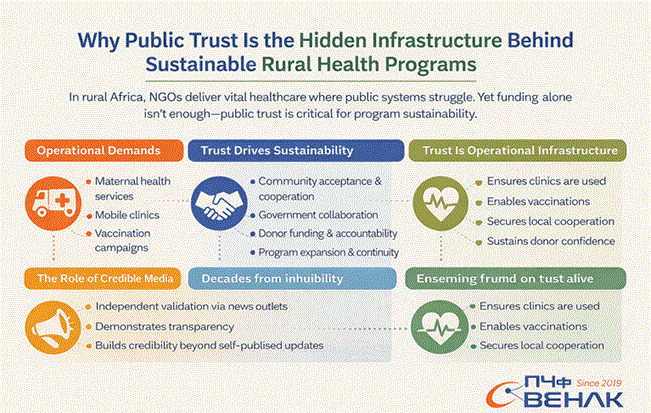
BY BEHAK PR Solutions – Across much of Africa, rural healthcare delivery depends heavily on non-governmental organizations. From maternal and child health services to vaccination campaigns, nutrition programs, and mobile clinics, NGOs often operate where public health systems are overstretched or inaccessible. Yet while funding, logistics, and medical expertise are essential, they are not sufficient on their own.
The long-term sustainability of rural health programs depends on something less visible but equally critical: public trust. In rural health settings, trust is not an abstract value. It determines whether communities accept services, whether local authorities cooperate, whether donors renew funding, and whether programs can expand beyond pilot phases. Without trust, even technically sound health interventions struggle to endure.
Trust Gaps in Rural Health Delivery
Rural healthcare programs operate in environments shaped by misinformation, cultural sensitivities, historical grievances, and limited access to verified information. Communities may be cautious about unfamiliar medical interventions or skeptical of external actors whose intentions are not clearly understood.
In this context, NGOs must earn trust continuously—not only through service delivery, but through transparency, consistency, and communication. Trust is reinforced when communities understand who is delivering services, why they are doing so, and how programs are accountable.
Trust also extends beyond beneficiaries. Ministries of health, regional administrations, donors, and implementing partners all assess whether an NGO operates responsibly and visibly. Credibility in the public domain reinforces confidence across this entire ecosystem.
Rural Health Delivery in Ethiopia: A Case in Point
Ethiopia illustrates this dynamic clearly. While rural health outcomes have improved over the past two decades, significant gaps remain due to geography, dispersed populations, and infrastructure constraints. NGOs continue to play a central role in maternal health, nutrition, immunization outreach, and community health education.
Many organizations support health extension workers, operate mobile clinics, or fill capacity gaps in remote areas. These efforts often rely on cooperation with local authorities, donor confidence, and community acceptance.
In such environments, credibility determines continuity. NGOs that are trusted are more likely to secure local buy-in, maintain government partnerships, and receive sustained donor support. Those that remain invisible or poorly understood may face resistance or funding uncertainty—even when their technical performance is strong.
Why Media Credibility Matters for Health NGOs
Many health NGOs rely primarily on internal reports, donor submissions, and self-published updates to demonstrate impact. While these tools are necessary, they reach limited audiences and are inherently self-reported.
Credible media coverage plays a different role. Independent reporting signals that an organization’s work has been externally observed, assessed, and deemed relevant. For sensitive health interventions, this third-party validation carries significant weight.
For donors and public authorities, credible media references help answer key questions:
- Is this organization actively engaged on the ground?
- Is its work visible beyond internal documentation?
- Does it operate transparently in complex environments?
- Is it accountable to the public, not only to funders?
In many cases, a single responsible media feature can strengthen confidence more effectively than multiple internal publications.
Independent Validation Versus Self-Published Narratives
Websites, newsletters, and social media channels remain important for transparency and engagement. However, they are increasingly viewed as controlled narratives.
Independent media coverage differs because it reflects editorial judgment. Journalists and editors decide what is credible, newsworthy, and worth public attention. For external stakeholders, this distinction matters—particularly in environments where misinformation can spread quickly.
In rural health contexts, professional media plays a stabilizing role. It anchors public understanding in verified information rather than rumor, speculation, or fragmented narratives.
Trust as a Funding Enabler
Funding for rural health programs is often multi-year and risk-sensitive. Donors assess not only outcomes, but reputational exposure. Organizations facing unclear public narratives or visibility gaps may encounter delays or hesitation, even when operational performance is strong.
NGOs with a consistent and credible public record are easier to support. Their leadership appears accountable, their work is easier to justify internally, and their programs are perceived as lower-risk investments. Strategic communication therefore becomes part of funding sustainability—not a peripheral activity.
Communicating Challenges Builds Confidence
Rural health programs inevitably face challenges: supply disruptions, staffing shortages, cultural resistance, or external shocks such as conflict and climate stress. Responsible communication about these challenges does not weaken trust—it strengthens it.
Media engagement allows NGOs to explain constraints, demonstrate adaptive strategies, and show learning. Transparency reassures donors and partners that difficulties are being managed professionally.
Silence, by contrast, can invite suspicion. In the absence of credible public information, stakeholders may assume problems are being hidden rather than addressed.
Digital Voices and Professional Confidence
Beyond traditional media, digital platforms increasingly shape perceptions of health interventions. Health professionals, development practitioners, and policy actors regularly discuss public health issues in professional and online spaces.
When credible voices engage constructively with an NGO’s work—by contextualizing impact or acknowledging progress—it reinforces legitimacy. This is not promotion; it is professional discourse that builds confidence among peers and funders.
In conclusion, Trust Is Operational Infrastructure
For rural health NGOs, trust enables access. It influences whether clinics are used, vaccinations are accepted, and health education succeeds. It also shapes cooperation with authorities and continuity of funding. Public trust is not a by-product of success. It is operational infrastructure.
For NGOs delivering health services in rural Africa, building and maintaining credible public trust is not optional—it is essential for sustained impact.
EDITOR’S NOTE:
BEHAK PR Solutions is an Africa-focused strategic communications and public relations firm headquartered in Addis Ababa, Ethiopia and publisher of New Business Ethiopia. Established in 2019 by veteran journalists, the firm delivers public relations services grounded in credibility, media intelligence, and a deep understanding of Africa’s political, institutional, and media landscapes.
BEHAK’s work spans five core service areas: Strategic Communication & Advisory, Media Relations & Publicity, Crisis Management & Response, Digital PR & Content Marketing, and Event Management & Measurement, supporting organizations seeking to build trust, manage reputation, and engage effectively with regional and global audiences.