
By Africa Risk Control – Investment opportunities, five-year sector performance, practical risk mitigations, and why Enhanced Due Diligence is essential.
Nigeria remains one of the most investable digital markets in Africa because it combines scale, necessity, and a fast-evolving innovation layer. The country’s payments and fintech story is not simply a “technology trend”; it is a structural response to a real economic need. When a large share of adults remain unbanked or underserved, digital financial services become the infrastructure that expands access, reduces transaction friction, and enables commerce at national scale. The World Bank has highlighted that Nigeria’s fintech and digital payments ecosystem has the potential to bridge access gaps, particularly in rural and underserved areas where traditional banking coverage is limited.
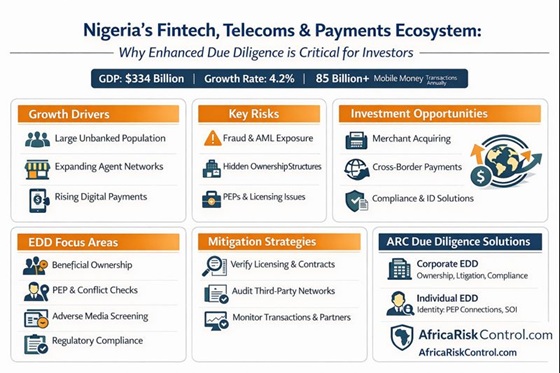
From an investor’s perspective, the opportunity sits across a connected value chain: telecom networks and distribution, payment rails, mobile wallets, merchant acquiring, agency networks, payroll and remittances, lending overlays, and compliance/identity solutions that make the system safer and more scalable. This ecosystem effect is also why Nigeria can generate outsized outcomes—winners can scale quickly once trust, liquidity, and distribution are secured.
Nigeria’s macro context matters because payments businesses ultimately monetize transaction volume, float, credit performance, and merchant density—each sensitive to inflation, exchange-rate dynamics, and policy direction. The IMF’s DataMapper profile places Nigeria’s GDP (current prices) at about US$334.34 billion and notes real GDP growth around 4.2% (IMF WEO profile view). At the policy level, recent macro reforms and monetary adjustments have been central to the operating environment; for example, Reuters reported the Central Bank of Nigeria cutting its policy rate in September 2025 (the first cut since 2020) after inflation eased. These shifts influence consumer purchasing power, loan performance, and the cost of capital for fintechs.
How the sector has performed in the last five years
Over the past five years, Nigeria’s fintech and digital payments space has moved through three distinct cycles: acceleration, correction, and consolidation.
First, there was broad acceleration driven by smartphone adoption, agent networks, and demand for faster payments. During this period, consumer behavior shifted decisively toward digital channels, and businesses began to treat payments as a growth lever rather than back-office plumbing.
Second, the ecosystem experienced a tougher cycle as macro volatility and tighter funding conditions forced a more disciplined approach. In practical terms, this period pushed the sector away from growth-at-all-costs and toward operational efficiency, risk management, and regulatory alignment.
Third, the most recent phase has been consolidation and infrastructure deepening: better rails, stronger compliance expectations, and a focus on building sustainable unit economics. The broader mobile money market has also continued to expand at a global level. GSMA reported a significant year-on-year rise in mobile money transaction volumes (reaching 85 billion annually) and highlighted major transaction value growth in its industry reporting, indicating strong structural demand for mobile money and digital payments. While GSMA figures are global, Nigeria’s scale and fintech density mean it is one of the markets most exposed to—and able to capture—these structural shifts in consumer payment behavior.
Importantly, the World Bank’s framing remains highly relevant to Nigeria’s last-five-year trajectory: digital payment platforms can expand access where physical banking is scarce, and the fintech layer can close practical gaps in inclusion and commerce. For investors, the key insight from the five-year performance is this: Nigeria’s payments ecosystem has demonstrated persistence through volatility, but the winners are increasingly those with credible governance, compliant distribution models, and robust risk controls.
Where the best investment opportunities sit now
Nigeria’s most compelling opportunities are those tied to real transaction flows and scalable distribution. Merchant payments and acquiring remain attractive where platforms can prove reliable uptime, fraud controls, and effective merchant support. Agency banking and last-mile cash-in/cash-out are still critical in a country where cash remains present in daily commerce, but the winning models are those with traceability, strong agent governance, and durable liquidity management.
There is also growing opportunity in the “middleware” layer: compliance technology, identity and verification solutions, transaction monitoring, and tools that help banks and fintechs reduce financial crime risk while improving onboarding. These segments grow as the ecosystem matures because regulators and institutional partners demand higher assurance.
Cross-border payments and trade-related payments are another investable lane, particularly as regional commerce expands. However, cross-border growth only becomes durable when compliance and counterparty governance are treated as product features—not afterthoughts.
Challenges investors must price in
Nigeria’s fintech upside is inseparable from operational complexity. At the commercial level, the most common challenges include margin pressure from competition, the cost of acquiring and retaining agents and merchants, and the operational burden of maintaining trust in high-volume systems.
At the regulatory and integrity level, the risks are more consequential. Payments ecosystems attract fraud because they are high throughput and often involve large networks of third parties—agents, aggregators, merchants, and intermediaries. Any weak link can introduce reputational and enforcement risk. In addition, licensing claims and regulatory standing matter: investors must verify whether an operator is properly authorized for the activities it performs, and whether it is compliant in practice—not just in marketing.
Macroeconomic conditions can also amplify risk: inflation impacts consumer ability to repay (where credit overlays exist) and increases operational costs; exchange-rate dynamics affect imported technology and capital planning; and policy shifts can change the economics of fees, settlement, or liquidity requirements. The World Bank’s Nigeria Development Update content emphasizes the importance of sustaining an appropriate policy mix to stabilize inflation and protect households, underlining the linkage between macro conditions and real-economy behavior.
Practical mitigation strategies for serious investors
Nigeria is not a market where investors should rely only on financial models and market size. Execution discipline determines outcomes. High-performing investors typically mitigate risk through structured entry and governance controls: phased exposure rather than immediate scale bets, clear contractual protections, audit rights over critical third parties, and robust compliance commitments embedded into commercial agreements.
Operationally, the most effective mitigation is governance over networks. If a fintech relies on agents, aggregators, or merchant networks, investors should require demonstrable controls around onboarding, monitoring, disciplinary processes, and transaction oversight. Where lending is involved, underwriting discipline and collections integrity must be validated—not assumed.
Finally, investors should treat reputation and enforcement risk as quantifiable. The cost of a compliance failure is not only regulatory; it is distribution disruption, partner loss, and valuation impairment. This is why structured due diligence should be integrated early in the investment process.
Why Enhanced Due Diligence is critical in Nigeria’s fintech and payments deals
In Nigeria’s digital economy, deals typically fail for reasons that are not visible in pitch decks. The problems appear later, during scaling, partnerships with regulated institutions, or cross-border expansion. This is where Enhanced Due Diligence (EDD) becomes decisive.
In practical terms, EDD is how investors validate the integrity of the “invisible” risk factors: who truly controls the business, whether beneficial ownership is transparent, whether there are politically exposed persons (PEPs) or conflicts of interest embedded in ownership or key relationships, whether past disputes or adverse media are material, and whether the company’s third-party networks are governed or unmanaged.
Because fintech ecosystems are network businesses, counterparty risk is not limited to the target company. It extends to major vendors, agent managers, and intermediaries that can create sanctions, fraud, or reputational exposure. Without EDD, investors can enter the market with strong unit economics on paper and still suffer value destruction from governance surprises.
ARC’s Enhanced Due Diligence support
Africa Risk Control supports Nigeria-focused investors and partners with two complementary services.
Individual Enhanced Due Diligence focuses on founders, key executives, major agents/intermediaries, and any stakeholder with meaningful influence over licensing, regulatory pathways, or distribution power. Corporate Enhanced Due Diligence focuses on the fintech or telecom-related entity itself, including beneficial ownership and control mapping, related-party exposure, litigation and regulatory standing, sanctions/adverse media screening, and integrity risk assessment tailored to the business model and transaction type.
EDITOR’S NOTE– Africa Risk Control (ARC) is a due diligence and risk advisory service provider operating in dozens of African countries. Corporate Due Diligence, Risk Advisory, Country Risk Insights, Background Checks, Identity Verification (for banks, governments, and institutions), Verification for Citizenship by Investment / Donations Programs, Verification for Permanent Residency by Investment / Donation Programs, Source Wealth Verification, Competitor Intelligence, and Market Entry Research are some of the major services ARC has been providing.