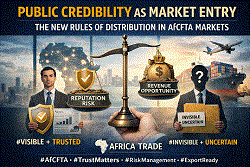

By BEHAK PR Solutions – Every serious business relationship begins with a quiet screening process. Long before contracts are discussed or formal due diligence begins, potential partners, distributors, and investors conduct a basic credibility check.
They search for the company online, review what appears in news results, and assess whether the business has an independent public footprint. What they find often determines whether a conversation progresses or quietly ends.
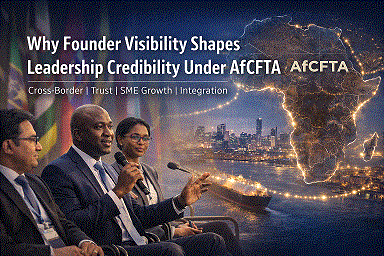
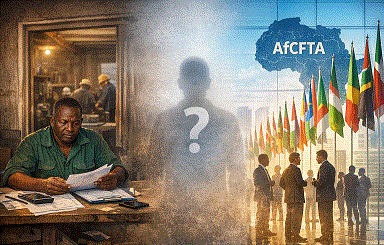
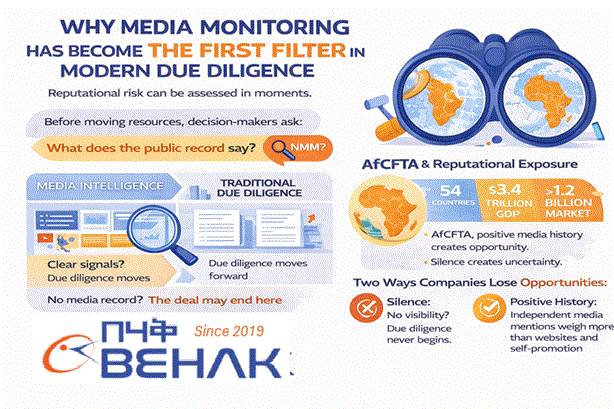
The African Continental Free Trade Area (AfCFTA) was established through an agreement signed in 2018 and officially commenced trading in January 2021. It brings together 54 African countries, making it the largest free trade area in the world by number of participating states. AfCFTA aims to create a single continental market for goods and services, facilitate the free movement of business persons and investments, and strengthen Africa’s position in global trade by promoting intra-African commerce, industrialization, and regional value chains.
As AfCFTA expands the range of potential partners across borders, it also increases scrutiny. Businesses are no longer assessed only within their domestic environments. They are compared against peers across the continent, often by people with no local familiarity. In this context, being visible in credible, independent media has become a decisive advantage.
Informal Due Diligence Starts With Media Searches
Before engaging advisors or requesting documents, decision-makers want quick answers to basic questions. Is this company active? Is it legitimate? Has it been publicly referenced? Is there any indication of controversy or instability?
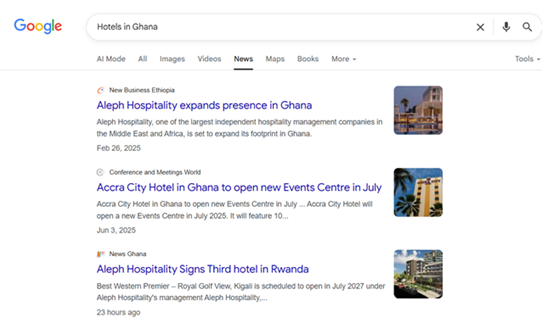
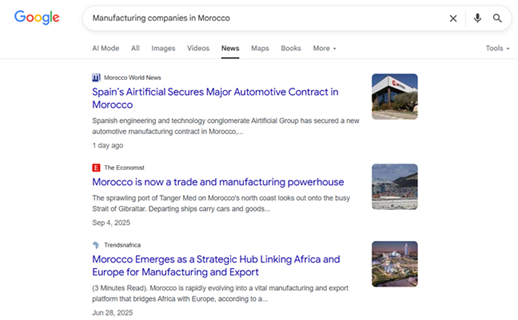
Google News has become one of the fastest tools for answering these questions. Media mentions provide third-party signals that a business has been visible to editorial scrutiny and deemed relevant beyond its own marketing claims. This initial screening happens silently, but its impact is significant.
A Cross-Border AfCFTA Scenario
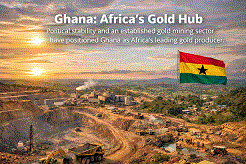
Imagine a manufacturing firm based in Ghana seeking a distribution or strategic partnership with a company in Morocco to access North African and European-linked markets. Before scheduling meetings or requesting proposals, the Moroccan firm conducts a basic background review. Executives search for the Ghanaian company in business media and regional trade coverage to understand its track record and market relevance.
If the Ghanaian manufacturer appears in credible business articles, trade discussions, or industry interviews, it signals seriousness and operational maturity. If it exists only through its website and social media pages, uncertainty increases. Even if the product quality is strong, the lack of independent references raises questions that may delay or derail engagement. This type of assessment is increasingly common across AfCFTA markets.
Why Media Mentions Carry More Weight Than Owned Content
Most businesses invest in websites and social media, and rightly so. However, from a due diligence perspective, these platforms are considered self-reported sources. They reflect how a company wants to be seen, not how it has been assessed by others.
Many SMEs assume that visibility is cumulative—that appearing on multiple business directories, maintaining a company website, or having an active social media presence creates credibility. In practice, these forms of visibility carry limited weight in reputational assessment.
A single press release, interview, or feature published by a credible, independent media outlet often has far greater impact than ten directory listings or a well-designed website. This is because media coverage represents third-party validation. It signals that the business has been assessed, referenced, and deemed relevant by an external actor rather than simply promoting itself.
How Businesses Found in Google News Are Advantage in AfCFTA and Global Partnerships
Independent media coverage plays a different role. It indicates that journalists, editors, or industry observers found the company relevant enough to reference. This external validation matters when risk is shared across borders.
For partners unfamiliar with a company’s local context, media mentions become a proxy for credibility.
Many SMEs assume that visibility is cumulative—that appearing on multiple business directories, maintaining a company website, or having an active social media presence creates credibility. In practice, these forms of visibility carry limited weight in reputational assessment.
A single press release, interview, or feature published by a credible, independent media outlet often has far greater impact than ten directory listings or a well-designed website. This is because media coverage represents third-party validation. It signals that the business has been assessed, referenced, and deemed relevant by an external actor rather than simply promoting itself.
The Hidden Advantage of Being “Searchable”
Companies that appear in Google News results enjoy a subtle but powerful advantage. They are easier to verify, easier to explain internally, and easier to defend during internal approval processes.
Invisible companies are not necessarily weaker. They are simply harder to assess. In competitive AfCFTA environments, that disadvantage is often decisive.
Why SMEs Underestimate This Reality
Many small and medium enterprises assume that media visibility is something to pursue after expansion has begun. In practice, expansion often depends on visibility already being in place.
Opportunities arise unpredictably. When they do, partners look for businesses they can evaluate quickly. Companies with established media footprints move forward smoothly. Others struggle to establish credibility under time pressure.
Visibility as Long-Term Preparation
Media presence is not built through a single announcement. It develops through consistent engagement over time. Interviews, business features, and industry commentary accumulate into a public record that supports future due diligence.
For African SMEs navigating AfCFTA and global markets, this preparation increasingly separates those who advance from those who are overlooked.
AfCFTA Rewards the Verifiable
AfCFTA expands opportunity, but it also expands choice. As partners compare options across multiple countries, they favor businesses that are visible, verifiable, and accountable. Being found in Google News does not guarantee success. Not being found, however, often guarantees exclusion.
EDITOR’S NOTE:
BEHAK PR Solutions is an Africa-focused strategic communications and public relations firm headquartered in Addis Ababa, Ethiopia. Established in 2019 by veteran journalists, the firm delivers public relations services grounded in credibility, media intelligence, and a deep understanding of Africa’s political, institutional, and media landscapes. BEHAK’s work spans five core service areas: Strategic Communication & Advisory, Media Relations & Publicity, Crisis Management & Response, Digital PR & Content Marketing, and Event Management & Measurement, supporting organizations seeking to build trust, manage reputation, and engage effectively with regional and global audiences.