
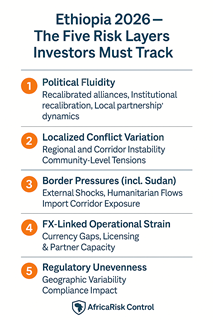
Ethiopia’s 2026 operating environment is shaped by multiple layers of risk that intersect in ways many investors underestimate. While national-level indicators provide a starting point, Africa Risk Control’s (ARC) field intelligence shows that the real exposure comes from the interaction of political, security, economic, regulatory, and geographic dynamics. Investors preparing for 2026 must understand how these layers contribute to both strategic opportunity and operational vulnerability.
The first layer is political fluidity, which continues to define the pace of reform, administrative consistency, and the relationship between federal and regional authorities. Political recalibration is influencing institutional behavior, decision timelines, and local partnership dynamics. Investors relying on political assumptions from previous years risk misinterpreting the real operating landscape.
The second layer is security and conflict variation. Ethiopia’s security environment is not uniform. ARC’s multi-region reporting shows significant contrasts between areas experiencing stabilization and those facing continued disruptions. Localized clashes, community-level tensions, mobility risks, and corridor instability still influence logistics, supply chains, and project timelines. No investor can afford to ignore these regional variations.

The third layer relates to border pressures and external shocks. The ongoing instability in Sudan and tensions along Ethiopia’s borders affect humanitarian flows, informal trade, cross-border mobility, and security conditions in adjacent districts. These dynamics shape corridor reliability and sector-specific exposure, particularly in logistics, agribusiness, infrastructure, and energy.
The fourth layer is economic and FX-linked pressure, which continues to influence operational continuity. FX delays affect procurement cycles, pricing stability, and partner capacity. These are not simply financial risks — they are operational risks that impact real-world timelines. Companies with heavy import dependency must factor this into their 2026 planning.
The fifth and often overlooked layer is regulatory and administrative unevenness. The variability in licensing procedures, documentation requirements, and institutional responsiveness has grown more pronounced across regions. These differences shape feasibility studies, compliance strategies, partner selection, and project rollout.
ARC’s Ethiopia Country Risk & Due Diligence Report — 2026 Q1 Premium Edition integrates these five layers into a forward-looking risk framework supported by on-the-ground reporting across Ethiopia and ARC’s 32-country intelligence network. For investors and operators seeking clarity in 2026, understanding how these layers interact is essential for realistic planning and effective mitigation.
In an environment where information gaps can lead to costly missteps, structured intelligence remains the foundation of sound investment decisions.
Unlike traditional consultancies, ARC is powered by a network of investigative and business journalists in 32+ African countries. With boots on the ground, Africa Risk Control uncovers realities beyond desk research — from hidden ownership structures to political exposure, regulatory shifts, and reputational risks.
Request free Summary: info@africariskcontrol.com
Get Ethiopia Micro Risk Brief Q1/2026
You can also book Supplementary Intelligence Briefing call here
Ethiopia Country Risk Profile 2026 is also Now Available.
To Learn More About Africa Risk Control’s Services, Book A 20-Minute Free Consultation Here.