
Africa Risk Control (ARC) has stated that Ethiopia’s investment and business environment for 2026 will require companies to rely more heavily on local and field-based intelligence due to rapidly evolving political, economic, and security conditions.
ARC’s analysis shows that while Ethiopia remains a high-potential market, changes in administrative behavior, shifting political balances, localized friction, and supply-chain volatility require closer monitoring than in previous years. The organization reports that regional dynamics are increasingly influencing investment feasibility.
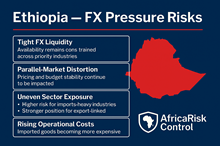
Foreign-exchange pressure continues to challenge businesses dependent on imported goods. ARC notes that many organisations underestimate the cascading operational impact of FX delays, which can affect procurement timelines, spare-part availability, and production schedules.
Security-related uncertainty remains a factor as well.
While the national situation shows signs of improvement, ARC highlights ongoing district-level disturbances, border-area pressures linked to Sudan, and sporadic mobility restrictions affecting business operations.
For sectors including logistics, agribusiness, energy, and manufacturing, ARC says that the ability to identify region-specific risks and anticipate short-term disruptions will be essential.
The organization emphasizes that Ethiopia’s 2026 outlook cannot be assessed solely through national policies or high-level economic indicators. Local realities and field-verified data will shape business outcomes.
Request the free Executive Summary: info@africariskcontrol.com
Get the full 107-page Premium Report
Book a 20-minute consultation
Africa Risk Control is launched by a group of award winning business & investigative journalist and due diligence experts in Africa to help global investors, corporations, and institutions make confident decisions in Africa’s dynamic markets.