
Ethiopia’s business environment in 2026 will be influenced by a combination of political, economic, and security pressures that investors must assess carefully, according to new analysis released by Africa Risk Control (ARC). The firm’s latest Ethiopia Investor Checklist highlights several emerging issues expected to shape market-entry and operational decisions in the year ahead.
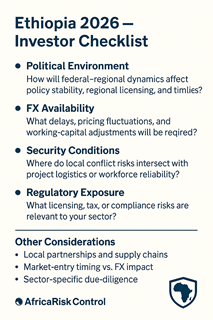
ARC’s findings indicate that political dynamics remain fluid, particularly in the relationship between federal institutions and regional authorities. While national reforms continue, the pace and consistency of implementation vary across regions. Analysts at ARC note that this divergence affects administrative predictability, licensing processes, land access, labor stability, and local partner engagement — areas that are central to foreign investment activity.
The report also emphasizes the ongoing impact of foreign-exchange (FX) shortages, which remain one of the most significant operational challenges for businesses in Ethiopia. Companies dependent on imported machinery, agricultural inputs, spare parts, and raw materials continue to face extended procurement delays and working-capital strain. ARC’s research shows that FX bottlenecks directly influence project timelines, pricing structures, and financial planning for both domestic and international firms.
Security conditions in Ethiopia present another layer of complexity. Although some regions have shown signs of stabilization, several areas continue to experience localized disturbances, community tensions, and intermittent mobility restrictions. ARC’s analysts underline that national-level security indicators alone do not provide sufficient visibility for investors planning operations or supply-chain routes.
Regulatory exposure is also a key consideration for 2026. Ethiopia is undergoing a series of policy adjustments across sectors such as logistics, telecommunications, agriculture, energy, and construction. However, reform timelines remain unpredictable, and investors may encounter inconsistencies between documented policies and actual implementation on the ground. ARC recommends close monitoring of sector-specific regulatory developments, compliance requirements, and enforcement practices.
ARC’s newly published Investor Checklist for 2026 consolidates these issues and provides a structured snapshot of the major risk considerations shaping Ethiopia’s investment landscape. According to the firm, the checklist should serve as an initial orientation tool rather than a substitute for full due-diligence procedures.
The checklist complements ARC’s more extensive Ethiopia Country Risk & Due Diligence Report — 2026 Q1 Premium Edition, a 107-page assessment covering political developments, FX diagnostics, region-level vulnerabilities, conflict hotspots, and sector-specific risk mapping.
ARC advises that investors planning expansion, new market entry, or operational restructuring in Ethiopia will benefit from pairing early-stage guidance with deeper field-based intelligence to strengthen decision-making and reduce exposure to uncertainty in 2026.
Africa Risk Control (ARC) offers comprehensive country risk analysis and investment advisory services to assist investors in navigating Ghana’s dynamic market. Our expertise ensures informed decision-making and strategic planning.